 Tiếng anh
 Vietnam
Which AED Brand Should You Buy? A Comparison of Popular AED Brands
Each AED brand has its own strengths. When considering which AED brand is best, buyers may look at Nanoomtech for its simplicity and ease of use; Mindray for its ability to deliver the first defibrillation shock in the shortest possible time; and ZOLL for its technology that provides real-time CPR quality guidance and feedback.
AED prices also vary depending on features, integrated technologies, and associated operating costs, rather than brand alone. Therefore, businesses should choose an AED based on their intended operating environment, required features, and long-term budget.
1. What is AED?
An AED (Automated External Defibrillator) can detect the heart's electrical signals through electrode pads (AED pads), then analyze them to identify dangerous heart rhythms such as ventricular fibrillation. If defibrillation is required, the device delivers a high-energy biphasic electrical current to eliminate all abnormal heart rhythms. The entire process, from applying the pads to obtaining the analysis results, usually takes only a few dozen seconds to less than one minute, helping minimize the time before intervention can be performed.
In terms of classification, AEDs currently on the market are divided into two main groups: semi-automatic (requiring the rescuer to press the shock button after the device detects an abnormal heart rhythm and issues a command) and fully automatic (delivering the shock automatically without any additional action). In addition, many modern AED models integrate voice-guided CPR instructions or real-time visual feedback on chest compression rate and depth, helping non-professionals perform cardiopulmonary resuscitation more correctly while waiting for an ambulance.
According to Decree No. 98/2021/ND-CP, AEDs are classified as medical devices based on their risk levels and must meet regulatory requirements for management, safety inspection, and technical performance before being marketed in Vietnam. Therefore, when researching which AED brand is best, buyers should not only consider the brand but also verify the legal status of the specific model.
2. What Popular AED Brands Are Currently Available on the Market?
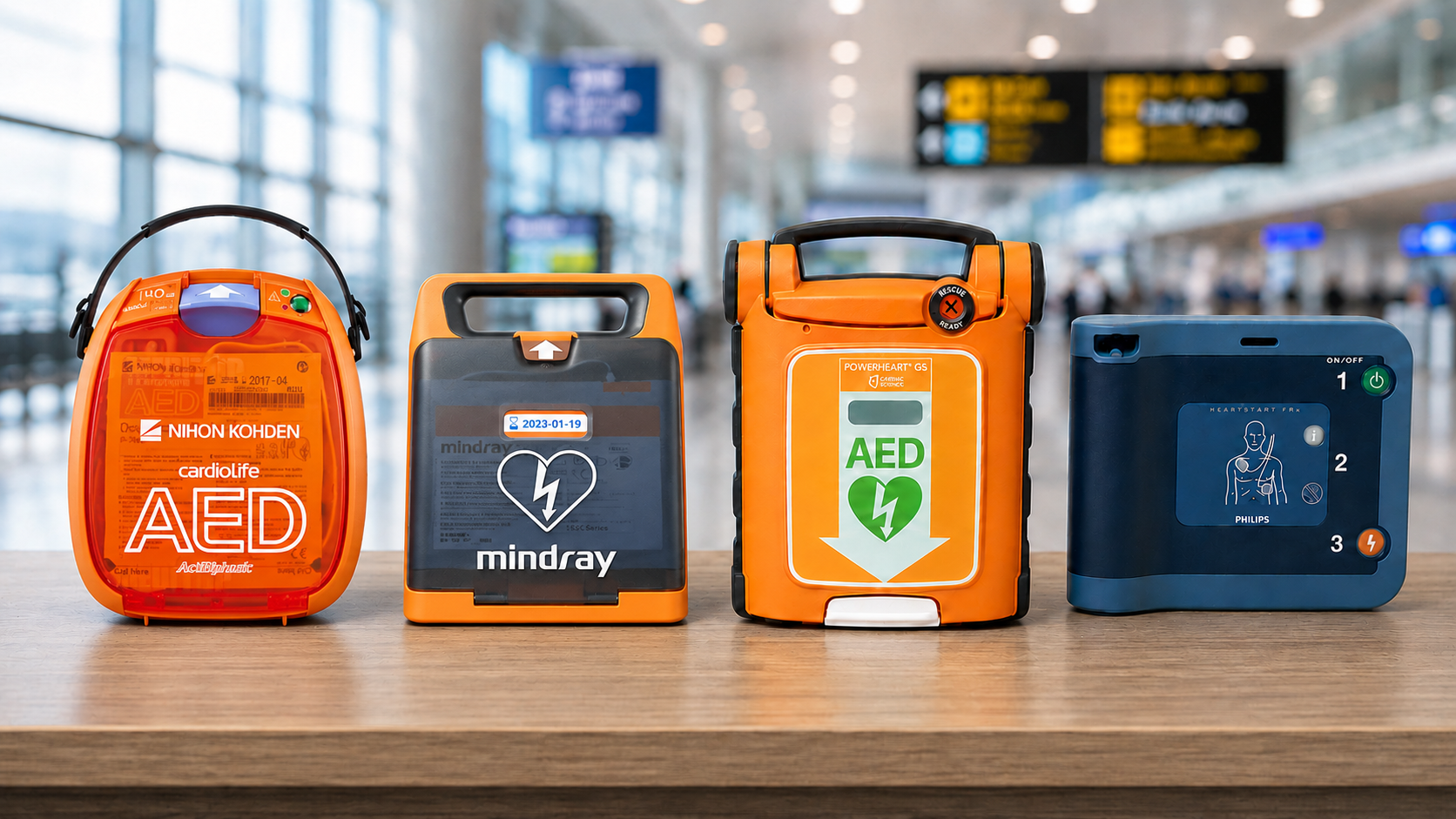
Many AED brands are used worldwide and in Vietnam. Some popular brands include Nanoomtech, ZOLL, Mindray, HeartSine (Stryker), and Defibtech. These are all manufacturers whose AED models are widely distributed in the international market.
In Vietnam, in addition to brands from the United States and Europe, users can also find AED models from Asia, such as NanoomTech (South Korea) and Nihon Kohden (Japan). Each brand has different characteristics in terms of features, operating costs, user support capabilities, and after-sales services.
3. Comparison Table of Proprietary Technologies Among Popular AED Brands
Each automated external defibrillator manufacturer develops its own proprietary technology to differentiate its products, going beyond basic heart rhythm analysis and defibrillation.
|
Brand |
Origin |
Outstanding Technology |
Practical Applications in First Aid |
|---|---|---|---|
|
NanoomTech |
South Korea |
Adult/Child mode switch; On-scene audio recording & ECG storage. |
Flexible mode switching without changing electrode pads; Stores data for handover to the 115 emergency medical team. |
|
Mindray |
China |
QShock (shock in less than 7 seconds); ResQNavi intelligent CPR guidance. |
Minimizes waiting time before shock delivery; Provides flexible guidance for untrained rescuers. |
|
Nihon Kohden |
Japan |
Heart rhythm analysis during CPR; Safe ActiBiphasic waveform. |
Helps maintain continuous chest compressions without interrupting blood flow to the brain; Protects heart muscle cells during defibrillation. |
|
Philips |
United States / Netherlands |
Low-current SMART Biphasic waveform; Accurate heart rhythm analysis. |
Prevents inappropriate shocks when defibrillation is not indicated; Voice guidance helps rescuers remain calm. |
|
Zoll |
United States |
Real CPR Help measures compression force/rate; See-Thru CPR artifact filtering. |
Provides direct feedback such as "Push Harder" to achieve the standard compression depth of 5–6 cm; Durable in harsh conditions. |
4. AED Prices by Market Segment
AED prices vary between brands mainly due to the level of integrated technology, rather than simply the brand name:
-
Entry-level segment (50 to million VND): Models that focus on basic operations, such as NanoomTech from South Korea.
-
Mid-range segment (50–75 million VND): Models equipped with additional technologies for rapid charging, analysis, and early shock delivery, including Mindray from China and Philips from the United States.
-
Premium segment (75–100 million VND or more): Models integrating comprehensive real-time CPR feedback and wireless connectivity for remote monitoring, such as the ZOLL AED 3 or Nihol Khoden from Japan.
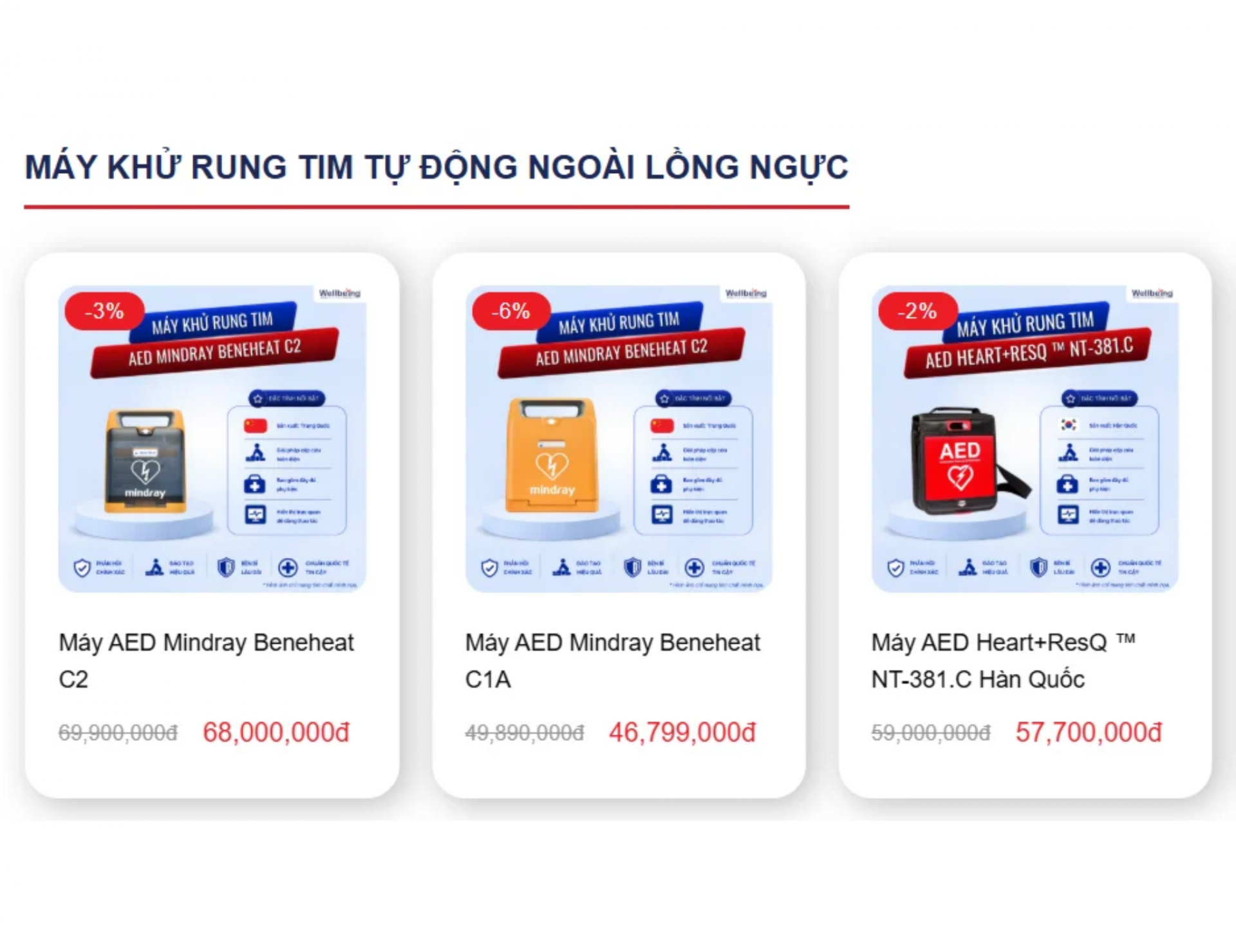
Wellbeing specializes in supplying AEDs across various price segments.
Specific prices in Vietnam also depend on import exchange rates, individual distributor policies, and whether CPR/AED training services are included. Therefore, these price ranges are only intended as general references.
5. Which AED Brand Is Suitable?
A brand should not be chosen solely based on its popularity. When considering which AED brand is best, businesses should compare the characteristics of the installation location with the actual features of each model:
-
Offices, schools, and low-risk facilities: Prioritize easy-to-use devices with clear voice instructions.
-
Businesses with many foreign employees: Consider models that support multiple languages.
-
Gyms and sports centers: Prioritize devices with CPR assistance or feedback features to support rescuers.
-
Businesses with multiple branches: Consider models that support remote device status monitoring.
-
Industrial or outdoor environments: Check the dust and water resistance (IP rating) of each specific model to ensure durability and operational capability.
There is no single AED brand that is best for every situation. The most suitable choice is a device that meets usage needs, users' operational capabilities, and the long-term maintenance budget.
6. Should AEDs With International Certifications Be Prioritized?
This is an important screening step before comparing features and prices. AED models approved by reputable regulatory authorities such as the FDA (United States) generally must meet requirements for heart rhythm analysis accuracy, defibrillation capability, and user guidance during emergencies.
In Vietnam, the minimum criterion to check is whether the device has a valid medical device registration number issued by the Ministry of Health under Decree No. 98/2021/ND-CP. This provides a basis for verifying that the device is permitted to be marketed before further evaluating its technology, features, or brand.
7. How Do Warranty Policies Differ Between AED Brands?
Warranty periods can vary significantly between manufacturers and individual models. Some AED models have main-unit warranty periods of several years, while certain premium models are advertised with longer warranty periods.
However, it is important to note that warranties for the main unit and consumable components are two separate policies. Components such as AED pads and AED batteries have their own expiration dates and must be replaced periodically, regardless of the main unit's warranty period.
When comparing brands, businesses should ask distributors to clarify the warranty period, warranty coverage, and support policies in Vietnam, rather than relying solely on warranty information published in manufacturers' international documentation.
8. Frequently Asked Questions (FAQ)
1. Are American AED brands better than those from South Korea or Japan?
This cannot be stated as a general rule. Quality also depends on the specific model, integrated features, and whether the device has a valid medical device registration number in Vietnam, rather than solely on the brand's country of origin.
2. Can I use electrode pads or batteries from another brand with my existing AED?
This is not recommended. AED pads and batteries are usually designed for specific models and are not interchangeable between brands or even between different models from the same manufacturer. You should purchase the correct genuine consumables for the AED model being used.
3. Is it mandatory to choose an AED brand with real-time CPR feedback?
No. This is a feature that helps improve chest compression quality, not a mandatory requirement for the device to operate. With a limited budget, a basic AED with a valid medical device registration number can still ensure the core emergency response function.
4. What is a reasonable AED price for a small business purchasing its first device?
For small businesses, the entry-level segment of approximately VND 25–45 to 55 million is generally a reasonable starting point, provided the device has a valid medical device registration number and a clear warranty policy from a distributor in Vietnam.
5. Should a company purchase different AED brands for its various branches?
This should be avoided if possible, because using multiple brands will complicate replacement consumables management (pads and batteries are not interchangeable) and employee training on different types of devices. It is advisable to standardize one brand and one model across the entire system if the scale allows.
6. Which AED brands are currently the most popular in Vietnam?
Nanoomtech, ZOLL, Mindray, and Nihon Kohden are all commonly supplied by many distributors in the market.
If your business is looking for an AED that meets its budget and actual usage needs, Wellbeing can provide consultation on device selection, analysis of criteria such as features and consumable costs, and implementation plans suitable for different types of facilities. Businesses can also receive consultation on AED placement, CPR training, and device operation instructions to become better prepared for emergency situations.
Investing in an AED is not just about purchasing a device, but also about developing an appropriate emergency response plan. Choosing the right device, fully budgeting for costs, and implementing it correctly will help businesses use AEDs effectively and maintain readiness when needed.
Comments:
There are no comment for this news.

.png)
.png)