 Tiếng anh
 Vietnam
Standard Protocol for External Chest Compressions | Wellbeing
Cardiac arrest is a critical emergency that can occur anywhere and at any time. The moment a patient is discovered in cardiac arrest, basic Cardiopulmonary Resuscitation (CPR) must be initiated immediately to maintain blood circulation to the heart and brain. Within the CPR protocol, the technique of external chest compression plays a pivotal role.
Preparation and Positioning Ideally, the procedure should be performed by doctors, nurses, or individuals trained in CPR techniques. Necessary equipment includes a crash cart, ambu bag, mask, endotracheal tube, monitor, defibrillator, and emergency medications like Adrenaline. The patient must be placed in a supine position (lying flat on their back) on a hard, firm surface. If the patient is on a mattress, a backboard should be placed under their back to ensure effective compressions.
1. Signs that a person may need cardiopulmonary resuscitation (CPR)
- Unresponsive:
Assess responsiveness for no longer than 10 seconds. If the person does not respond, they should be considered unresponsive.
○ For adults: Tap the person on the shoulder and call out loudly, such as “Sir/Madam, are you okay?”
○ For young children: Gently tap the sole of the child’s foot.
- Not breathing or only gasping (short, irregular, abnormal breaths that may occur during the first few minutes after cardiac arrest).
- No carotid or radial pulse.
2. Step-by-Step Procedure
-
Recognition and Initial Action: Upon discovering an unconscious patient suspected of cardiac arrest, quickly approach, assess the situation, and call for support. Position the patient correctly and immediately clear the airway while checking for breathing and a carotid pulse.
-
Compression Technique:
-
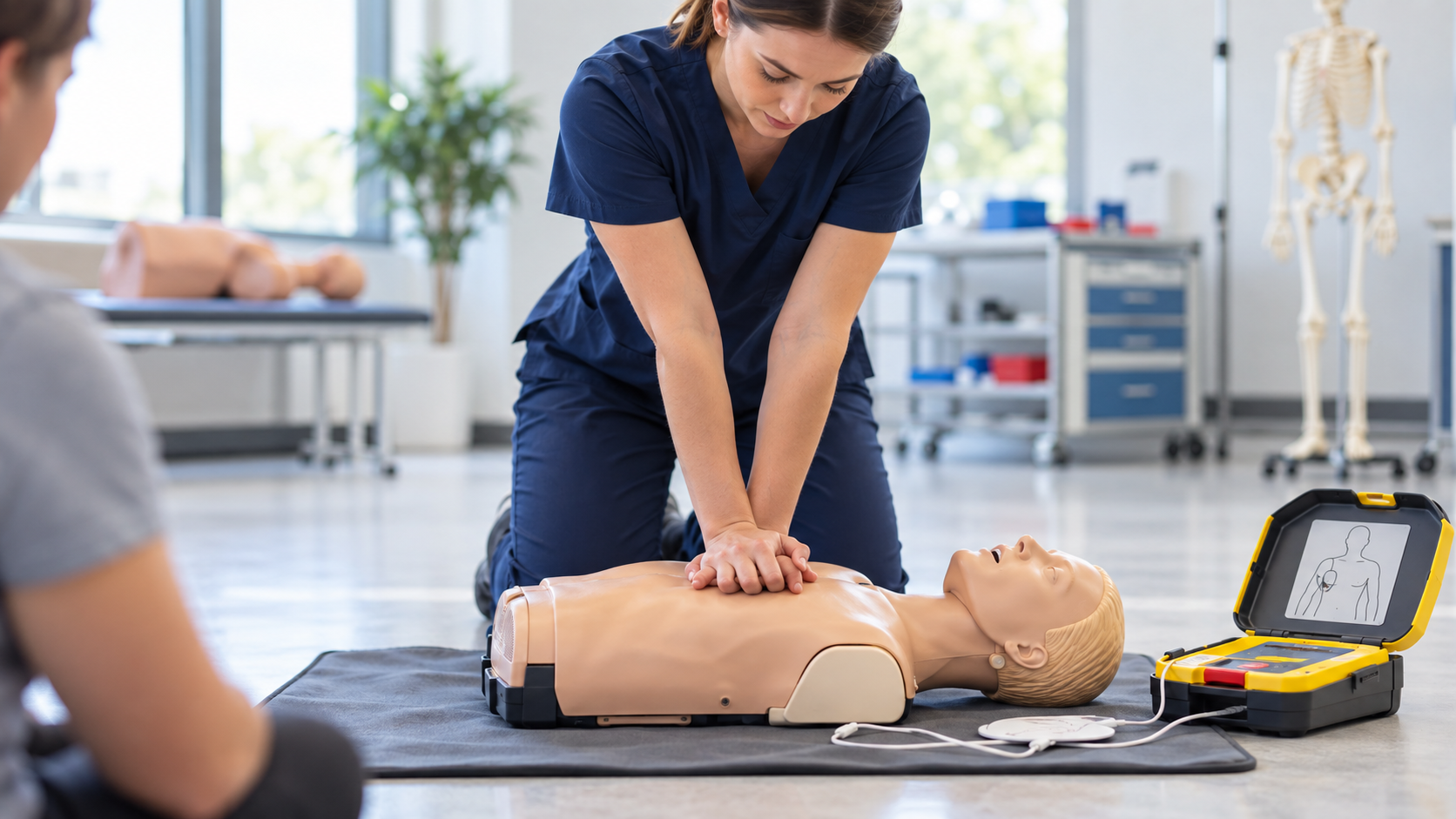
Hand Placement: Locate the xiphoid process (the lower tip of the breastbone). Place the heel of the first hand on the sternum, just above this point. Place the second hand on top of the first, interlocking the fingers tightly.
-
Body Mechanics: The direction of force must be perpendicular to the patient's chest. Keep your shoulders, elbows, and wrists locked in a straight line.
-
Action: The guiding principle is to push "Fast and Hard." Ensure the chest recoils (expands) completely after each compression and minimize interruptions.
-
-
Specific Ratios and Depth:
-
For Adults and Children (>8 years): Compress at the center of the chest (nipple line) to a depth of 4-5 cm using the heels of both hands.
-
For Infants (<1 year): Compress just below the nipple line (lower half of the sternum). Use the 2-finger technique (for a single rescuer) or the 2-thumb encircling hands technique (for two rescuers). The depth should be 1/3 to 1/4 of the chest thickness.
-
Frequency: Maintain a rate of at least 100 compressions per minute.
-
Ventilation Ratio: Perform 30 compressions to 2 breaths (30:2) for adults (and for children/infants with a single rescuer). Use a 15:2 ratio for children/infants if two rescuers are present.
-
Potential Complications If chest compressions are performed in the wrong location, with incorrect technique, or with excessive force, complications may occur, including rib fractures, sternum fractures, pneumothorax, or lung contusions.
3. Common Mistakes When Performing Cardiopulmonary Resuscitation (CPR)
- Moving the hands during chest compressions: This can shift the compression point away from the correct position and may increase the risk of rib fractures.
- Stepping or pressing on the chest with the foot: This does not provide controlled, continuous compressions and may cause additional injury to the chest and internal organs.
- Pressing the philtrum, pulling the sideburns, or applying pressure to acupressure points: These actions are ineffective when a person is in cardiac arrest.
- Transporting the person immediately to the hospital without starting CPR: This may waste the critical “golden time” when early resuscitation is most important.
- Panicking or delaying CPR: A delayed response can reduce the chance of successful resuscitation by wasting valuable time.
- Compressing too far to the left side of the chest: This is ineffective because the force is not applied to the correct compression point and may also cause chest injuries.
Conclusion
Cardiopulmonary resuscitation (CPR) is an essential first aid skill that helps temporarily maintain blood flow and oxygen delivery to the brain, heart, and other vital organs when a person experiences cardiac arrest. The effectiveness of CPR depends greatly on early recognition of the emergency, prompt initiation of chest compressions, correct compression rate and depth, and minimizing interruptions as much as possible.
CPR techniques should be adapted to different age groups, including adults, children, and infants under 1 year old. Therefore, rescuers need to understand the differences in hand placement, compression depth, rescue breathing techniques, and the use of an AED in order to avoid applying the wrong technique in a real emergency.
More importantly, CPR is a skill that should be learned and practiced regularly rather than only reviewed when an emergency occurs. Participating in first aid, CPR, and AED training helps learners develop the correct response, become more confident when facing sudden cardiac arrest, and contribute to improving the victim’s chance of survival.
Comments:
There are no comment for this news.

.png)
.png)