 Tiếng anh
 Vietnam
Chemical Spill Response Procedure
Chemical spills in the workplace can pose serious risks to human health, occupational safety, and the surrounding environment. Developing and strictly adhering to chemical spill response procedures in accordance with regulations is a mandatory requirement in chemical safety management, as well as a key factor in minimizing damage when a chemical spill occurs and ensuring the ability to respond to emergency chemical incidents in a timely and effective manner.
1. Danger Level of Chemical Spills
According to Article 4 of the 2007 Chemical Law, a chemical incident is a state of fire, explosion, leakage, or dispersion of chemicals that causes harm or poses a risk of harm to people, property, and the environment. A serious chemical incident is one that causes or poses a major, widespread risk of harm to people, property, and the environment, exceeding the control capacity of the chemical enterprise.
Chemical spills can occur in various situations, including during the handling, storage, or transportation of chemicals. The hazards associated with a chemical spill depend on the type and quantity of the chemical, its hazardous properties (toxic, flammable, corrosive, etc.), and the environment where the spill occurs. Early identification of the risk level and the timely implementation of chemical spill response measures are crucial foundations for ensuring chemical safety and limiting the spread of harmful effects.
Based on the scope and level of impact, emergency chemical incident response is divided into three levels:
-
Enterprise-level chemical incidents (Level 1)
Incidents that do not pose an immediate danger to life, property, the environment, production, and the economy. These situations can be controlled by on-site response measures. In this case, the enterprise must organize a command response force to immediately implement chemical spill handling measures according to the established plan. If the chemical incident exceeds the enterprise's capacity and on-site resources are insufficient for self-rescue, the enterprise must promptly report it to the Provincial Steering Committee for Chemical Incident Prevention and Response. The business owner where the incident occurs is responsible for commanding the scene until the provincial rescue force takes over.
-
Provincial/City Emergency State (Level 2)
Cases where the chemical incident causes certain dangers to life, property, and the environment (minor fires, explosions, chemical poisoning, etc.). Handling chemical spills at this level requires coordination between the enterprise, specialized forces, and support units according to the approved emergency chemical incident response plan. If the chemical incident exceeds the rescue capacity of the enterprise or industrial parks/clusters, the Provincial Steering Committee for Chemical Incident Prevention and Response will organize a rescue and propose the emergency mobilization of necessary resources from support units to respond early and avoid serious consequences. Scenarios with a risk of incidents at this level include: Leakage of Ammonia, Chlorine, or industrial gases; LPG leakage; oil spills at riverine or coastal port systems; fires or explosions at petroleum storage tanks; spills or leaks of chemicals such as Acid, Caustic Soda, Methanol, etc.; fires or explosions at gas stations or gas retail stores; fires or explosions at industrial explosive storage facilities with reserves up to 5 tons.
-
Disaster (National-level chemical incident / Level 3)
Cases where the chemical incident poses a severe danger to human life, the environment, or has the potential to destroy entire structures (fatalities, major fires, massive explosions, etc.). This situation can occur immediately or escalate from lower-level incidents due to a lack of control, progressively worsening. When the danger level exceeds the local response capacity, chemical spill handling and rescue operations must be organized on a national scale under the direction of the Government and specialized agencies, ensuring risk control at the highest level of chemical safety. Scenarios with a risk of incidents at this level include: Incidents at petrochemical refineries, alcohol production plants, gas bottling stations; petroleum storage facilities; industrial explosive storage facilities with reserves of 10 tons or more.
For chemical incidents occurring at the enterprise level (Level 1), if the chemical spill response procedures are followed correctly, adequate equipment is provided, and workers are trained according to chemical safety regulations, the incident can be quickly contained, minimizing its impact on production. Conversely, delayed or technically incorrect handling can cause the spill to spread, disrupt production, cause economic losses, and pose a severe safety risk to workers, necessitating the deployment of emergency response measures on a larger scale.
2. Chemical Spill Response Procedure
When a spill occurs, the top priority in the chemical spill response procedure is to ensure human safety before proceeding with collection and cleanup measures. The person who discovers the spill must quickly issue a warning, isolate the area, and prevent unauthorized access. Chemical spill handling must only be performed by individuals fully equipped with appropriate personal protective equipment (PPE) based on the chemical's properties, such as chemical-resistant clothing, gloves, safety goggles, respirator masks, or breathing apparatus. Simultaneously, it is necessary to quickly identify the spilled chemical, assess the danger level, the extent of the spread, and its potential to react with the surrounding environment.
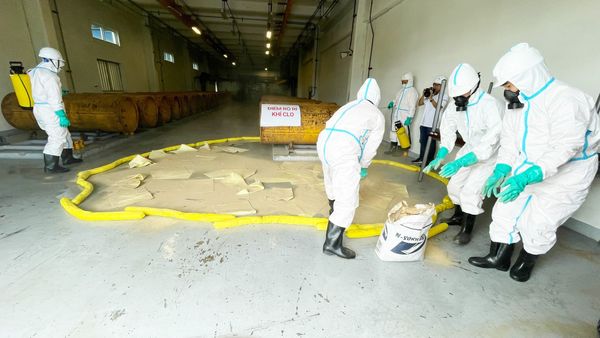
(The chemical spill area must be cordoned off with a perimeter fence. Photo: Internet)
-
Step 1: Secure the Spill Area
In the chemical spill response procedure, the first step is to shut off any sources that could cause ignition or escalate dangerous reactions, and simultaneously evacuate workers from the affected area if necessary. A safety perimeter must be established at the scene using containment booms, barrier pillows, or specialized obstacles to limit the chemical's spread, creating a control zone for subsequent cleanup operations. For chemical spills on water, using oil containment booms or chemical barrier booms to create a perimeter is mandatory to prevent the chemical from spreading and impacting the environment. Multiple layers can be used to form an effective barrier depending on the terrain and the severity of the incident.
-
Step 2: Stop the Source
Once the spill is contained, shut off the source. This means that when a chemical spill occurs on the floor, the source must be stopped first (closing valves or nozzles, turning over knocked-down cylinders, etc.). Promptly stopping the source is the deciding factor in the overall effectiveness of the spill response and creates safer conditions for the emergency response team.
-
Step 3: Clean up the Chemical
Use appropriate absorbents (chemical absorbent pads, oil absorbent pads, neutralizing powder, etc.), pillows, or liquid absorbent materials from the spill kit to clean up. Perform the cleanup from the outside in, moving from less hazardous areas to areas with higher concentrations. Use chemical/oil absorbent pads for quick absorption, maximum spill coverage, and to wipe up any residue left on the surface. Use pillows to absorb large volumes of liquid. Absorbent powder provides bulk absorption and is excellent for removing spills from cracks and crevices on rough surfaces. Guidelines for using absorbent powder:
-
Sprinkle the bagged absorbent powder over the surface of the spreading liquid. Sprinkle it low to avoid creating dust and waste.
-
After a few minutes, the powder will absorb and encapsulate the spilled liquid or neutralize acids.
-
Use a stiff broom to sweep back and forth until the floor is dry and clean. Typically, 1 kg of absorbent can soak up 2-4 kg of oil. If the floor still shows traces of oil, the absorbent is oversaturated, and more should be added.
-
-
Step 4: Dispose of Used Absorbents
Collect the solid waste (absorbent powder soaked with the spilled liquid) using a shovel and dispose of it according to the regulations of the local Environmental Protection Agency. Apply the appropriate waste disposal method depending on the type of chemical absorbed. The absorbed chemicals must be carefully collected, placed in hazardous waste containers, fully labeled, and disposed of in accordance with hazardous waste management regulations. The surface of the spill area must be further cleaned and decontaminated with a suitable solution, following the safety instructions for that specific chemical. The entire spill handling process must be strictly supervised to ensure no dangerous residues remain that could harm workers or the environment.
3. Prevention and Response to Chemical Spills
After completing the spill response steps, the enterprise must record, report, and evaluate the causes leading to the chemical spill. Reviewing the procedures for storing, transporting, decanting, and using chemicals is necessary to promptly rectify any unsafe conditions. At the same time, workers need regular training and drills on chemical incident response to improve their reaction capabilities in emergencies.
Article 36 of the 2007 Chemical Law stipulates the prevention of chemical incidents:
-
Organizations and individuals engaged in chemical activities must comply with technical safety regulations; periodically educate and train employees on chemical safety.
-
Investors of chemical activity projects not included in the List specified in Clause 1, Article 38 of this Law must develop Chemical Incident Prevention and Response Measures suitable for the scale, production conditions, and chemical properties.
-
Chemical incident prevention and response measures include the following basic contents: a) Identifying, zoning, and planning regular inspections for high-risk chemical incident points; b) On-site response measures, equipment, and forces; c) Coordination plans with external forces to respond to chemical incidents.
-
Investors of chemical activity projects included in the List specified in Clause 1, Article 38 of this Law must formulate a Chemical Incident Prevention and Response Plan and submit it to the competent state management agency for approval; the project can only commence operations after the Plan is approved. In case of scale expansion or changes in the scope of activities, the Plan must be amended, supplemented, and submitted to the competent authority for approval.
Article 37 of the 2007 Chemical Law stipulates equipment and forces for chemical incident response:
-
Organizations and individuals engaged in chemical activities are responsible for building on-site response capabilities and having equipment appropriate to the scale and properties of the chemicals.
-
On-site response forces must be regularly trained and practice chemical incident response plans.
-
Fire prevention and fighting forces, other forces, and relevant state management agencies are responsible for enhancing capabilities and equipment to respond to chemical incidents.
In the context of increasingly developing industrial production, chemical safety is both a legal requirement and a social and moral responsibility of every organization and enterprise. Chemical spill handling is a critical component of the occupational safety and environmental protection management system. A scientific response procedure that complies with standards and is executed by a well-trained team will help enterprises effectively control emergency chemical spills and minimize risks to human health and the working environment.
References:
-
Law Library, 2007 Chemical Law, accessed at: https://thuvienphapluat.vn/van-ban/Linh-vuc-khac/Luat-hoa-chat-2007-06-2007-QH12-59653.aspx
-
Vietnam National Institute of Occupational Safety and Health (VNNIOSH), Guidelines for on-site handling procedures for chemical spills at enterprises, accessed at: https://vnniosh.vn/huong-dan-quy-trinh-xu-ly-tai-cho-su-co-hoa-chat-tran-do-tai-doanh-nghiep/
-
Center for Environmental Safety Incident Response, Handling procedure for hazardous chemical spills, accessed at: https://ungphosuco.vn/quy-trinh-xu-ly-su-co-tran-do-hoa-chat-nguy-hai/
Comments:
There are no comment for this news.

.png)
.png)