 Tiếng anh
 Vietnam
First Aid Courses for Businesses in Hoi An
In the context of Hoi An's strong development in tourism and services with a high density of international visitors, the need for businesses to participate in first aid courses is becoming increasingly urgent. Not stopping at legal compliance requirements, first aid training is also an important part of the risk management strategy, helping businesses proactively respond to emergencies such as stroke, cardiac arrest, workplace accidents, or drowning.
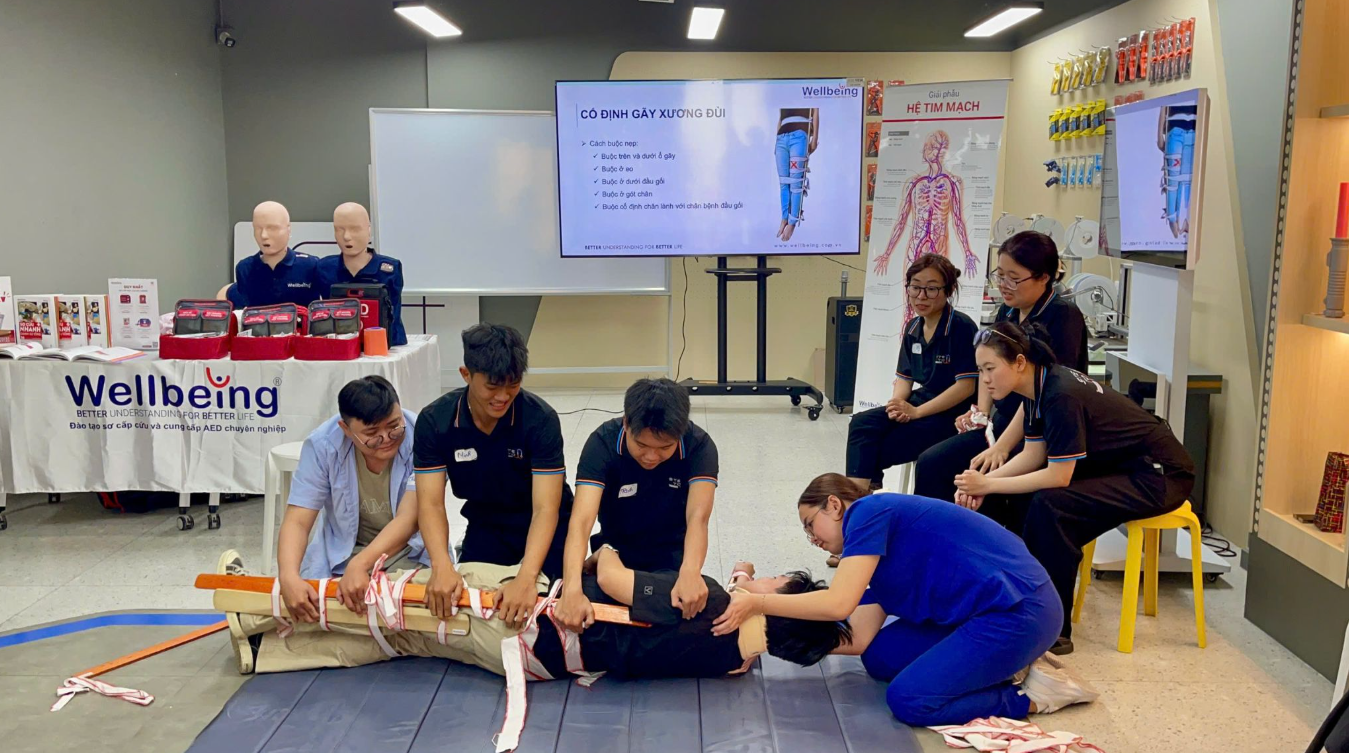
In the modern business environment in Hoi An, a first aid course is not only a legal requirement but also a strategic investment in human resources.
1. Why do businesses in Hoi An need to participate in first aid courses?
Unlike many other work environments, Hoi An has a specific service-oriented nature: hotels, resorts, riverside and seaside restaurants, and the crowded ancient town. This entails many hidden risks such as slips and falls, drowning, heatstroke, or cardiovascular problems in elderly tourists.
In these situations, the "golden window" only lasts from 3 to 5 minutes. If there is no timely intervention, the risk of death or severe complications is very high. A systematic first aid course helps on-site personnel become "first responders" who can:
-
Quickly recognize critical conditions.
-
Perform CPR with the correct technique.
-
Use an AED (automated external defibrillator) promptly.
-
Stabilize the victim before transferring them to a medical facility.
This is the key factor that makes the difference between a controlled incident and a severe medical crisis.
2. First aid courses and business legal requirements
According to the provisions of the Law on Occupational Safety and Health, businesses are required to organize periodic first aid courses for employees. The minimum ratio of trained personnel is usually 5% of the total workforce, especially in high-risk industries.
However, if training is only done for formality, businesses will struggle to achieve practical effectiveness. In many cases, employees have taken the course but cannot perform due to a lack of hands-on practice or unupdated skills. Therefore, the current trend is shifting from "training to meet conditions" to "training to be able to use immediately when needed."
3. Training content in the business first aid course
3.1. Training objectives
The first aid course program aims to help trainees understand the true nature of first aid, not just to "know" but to be able to "do" it. This is especially important in a business environment, where every decision in the first few minutes can directly affect human life.
Through the training process, trainees develop a mindset for handling situations according to standard procedures, from scene assessment to initial intervention. Repeated operations and continuous practice help form correct reflexes, minimizing errors when facing critical situations. This is the core factor that helps transform knowledge into practical capacity.
3.2. In-depth training content
Wellbeing's first aid course program is designed to integrate foundational theory with simulated practice. The difference lies in the fact that trainees not only receive information but are also placed in scenarios close to the reality of the business.
The internationally standardized training equipment, certified by the American Heart Association (AHA), allows for accurate assessment of each action, such as compression depth, CPR rate, or accuracy when handling a situation. This helps improve training quality and ensures trainees can apply it immediately after the course.
3.2.1. Cardiopulmonary Resuscitation (CPR) and AED usage
In a business environment, circulatory arrest can happen unexpectedly and is a leading cause of death. The first aid course focuses on CPR training as a core survival skill. Trainees are guided in detail from assessing the scene and calling for help, to chest compressions and coordinated rescue breaths. Specifically, the use of an AED is integrated into the training process. When high-quality CPR and an AED are combined in the first 3-5 minutes, survival rates can increase significantly, up to 70% in many cases.
3.2.2. Handling airway foreign bodies and choking situations
In a business environment, especially in dining areas, the risk of choking on foreign objects is always present. The first aid course helps trainees master airway clearance techniques like the Heimlich maneuver, with practice on mannequins to ensure accurate and safe operations. Understanding the mechanism and applied force helps learners avoid causing secondary injuries while improving handling effectiveness in real-life situations.
3.2.3. Bleeding control and bandaging wounds
Workplace accidents such as cuts, bleeding, or broken bones are common risks in many industries. The first aid course delves into bleeding control techniques using direct pressure, pressure bandages, or tourniquets when necessary. In addition, trainees are instructed on how to immobilize fractures and transport victims correctly, limiting the risk of spinal cord injury—one of the causes of long-term complications.
3.2.4. Stroke and myocardial infarction (heart attack) management
Work pressure and modern lifestyles increase the risk of stroke and cardiovascular diseases. In the first aid course, trainees are trained to recognize early signs such as facial drooping, weakness in limbs, chest pain, or shortness of breath. Early detection and correct handling in the initial stage not only save the victim's life but also significantly reduce the risk of disability.
3.3. Business first aid workshops: Flexible training solutions
Besides long-term programs, Wellbeing implements short-term workshops within the framework of the first aid course, lasting from 60 to 120 minutes. This format is suitable for businesses that need to quickly update knowledge or conduct large-scale training.
Workshops help employees access practical knowledge, participate in situation simulations, and interact directly with instructors. More importantly, this format contributes to building a rapid response network within the business.
4. Who is the first aid course for?
An effective first aid course does not limit its audience. Wellbeing designs programs for the entire human resources system, from managers and occupational safety departments to operational and administrative staff.
This approach helps businesses build synchronized response capabilities, avoiding reliance on a small group. When many people possess the skills, the ability to respond in an emergency will be faster and more effective.
5. Wellbeing - The unit implementing first aid courses in Hoi An
Wellbeing is a reputable first aid training provider with experience implementing programs for many businesses, international organizations, and hotel/resort systems in Central Vietnam as well as nationwide.
The training program is led by a team of medical experts, combining modern learning methods focusing on practice and real-life situations. Furthermore, Wellbeing provides integrated solutions from training to AED deployment, helping businesses build a comprehensive safety system.
Comments:
There are no comment for this news.

.png)
.png)