 Tiếng anh
 Vietnam
Corporate First Aid Training Program
In the modern work environment, the risk of accidents or health incidents always exists, ranging from simple situations like fainting to severe cases like cardiac arrest and stroke. Therefore, corporate first aid training is no longer a mere formality but has become a crucial component of the occupational safety system. A systematic training program helps businesses proactively handle risks on-site, reducing complete reliance on the external medical system, especially during the "golden window" that determines the victim's chance of survival.
1. Legal Basis and Role of Corporate First Aid Training
From a medical science perspective, the first three to five minutes after an accident occurs are called the golden window. For conditions such as circulatory arrest, myocardial infarction, or airway obstruction, if the brain is deprived of oxygen beyond this time limit, it will lead to irreversible neuronal damage. The victim's chance of survival depends entirely on immediate intervention measures by those present at the scene. Therefore, corporate first aid training is the only solution to fill the time gap before the out-of-hospital emergency system arrives.
Legally, in Vietnam, first aid training in the workplace is a mandatory obligation for employers. According to Circular No. 19 of 2016 from the Ministry of Health guiding the management of occupational hygiene and worker health, production and business establishments must organize an on-site first aid force. The percentage of employees required to undergo corporate first aid training is regulated based on the characteristics and risk levels of each industry. Complying with this regulation helps organizations complete their legal records and pass occupational safety inspections by state management agencies.
2. Benefits of First Aid Training for Businesses
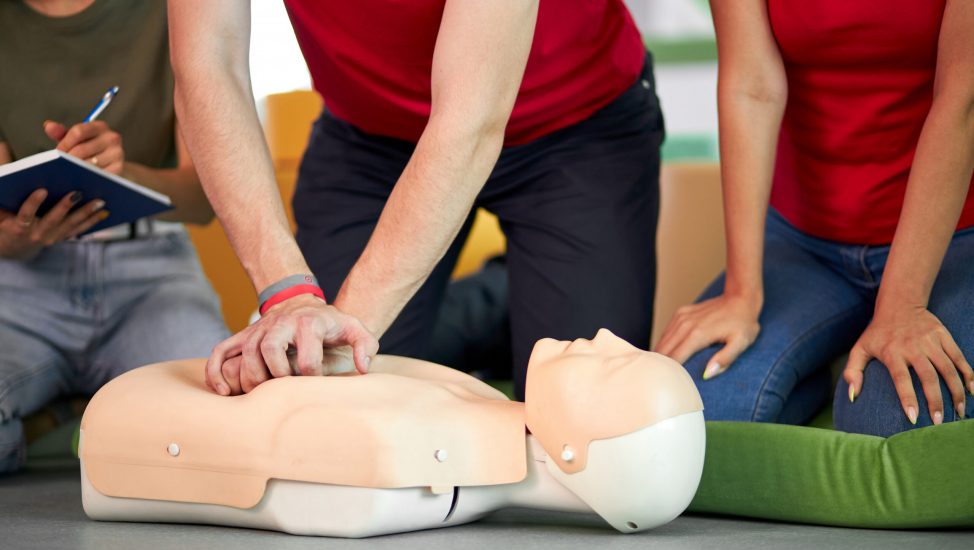
Allocating budget and time for medical training brings many measurable values in both human resources and financial aspects. The benefits of first aid training for businesses are clearly demonstrated across three core aspects.
-
First, minimizing the mortality rate and the severity of injuries. Applying the correct external chest compression techniques, arterial pressure bandaging techniques, or splinting broken bones helps maintain blood flow and prevent secondary injuries. An open wound, if properly disinfected and bandaged according to medical standards from the start, will eliminate the risk of blood infection, thereby shortening hospitalization time and accelerating the worker's rehabilitation process.
-
Second, optimizing operating costs and financial risk management. A strategic benefit of corporate first aid training is the ability to reduce the burden of medical costs and occupational accident compensation. When the severity of injuries is controlled at the lowest level, businesses will limit long-term shortages of specialized personnel, ensuring the continuity of the production line and avoiding disruptions in business operations.
Benefits of first aid training for businesses
-
Third, enhancing employee engagement indices and building a safety culture. When businesses proactively organize practical training courses, workers will recognize the organization's concern for their personal health and safety. Peace of mind regarding the work environment helps boost labor productivity and builds the image of an employer with high social responsibility in the market.
3. Medically Standardized Corporate First Aid Training Content
To ensure trainees can apply what they learn in reality, the corporate first aid training content must be designed based on the principle of assessing victims from the highest to the lowest level of life threat. The standard lecture structure recommended by medical associations includes the following specialized modules:
Module on Cardiopulmonary Resuscitation (CPR) and Using Automated External Defibrillators (AEDs)
This is the most important knowledge section aimed at handling sudden circulatory arrest syndrome. The corporate first aid training content in this module requires trainees to master the chest compression rate, the depth of chest compressions, the ratio of compressions to breaths, as well as the procedure for attaching electrode pads and operating an automated external defibrillator safely for both the victim and the rescuer.
Module on Hemorrhage Control and Handling Mechanical Injuries
Medical instructors guide the classification of wounds, methods of washing, and surface disinfection. The focus of the module is on direct pressure bandaging techniques to stop bleeding, how to use a triangular bandage for arm slings, and the standard method of applying a tourniquet to halt arterial blood flow in the event of an amputated limb.
Module on Bone/Joint Immobilization and Moving the Victim
For accidents caused by slips, falls, or mechanical impacts, the corporate first aid training content must strictly include techniques for using medical splints to immobilize suspected broken bones. Trainees learn how to immobilize cervical spine injuries and safe postures for transporting victims out of dangerous areas using stretchers or bare hands.
Module on Handling Specific Emergency Situations
Depending on the industry, the program will supplement how to handle airway obstructions using abdominal thrusts, methods for cooling high-temperature burns, how to flush eyes when splashed with chemicals, first aid for electric shock victims, recognizing signs of stroke, hypoglycemia, or acute food poisoning.
4. Corporate First Aid Training Program from the Wellbeing Organization
In today's market, choosing the right provider to implement corporate first aid training directly determines the output quality of the program. Among them, Wellbeing is one of the intensive training organizations with a systematic program built according to medical standards and has been deployed for many large businesses and organizations in Vietnam.
4.1. About Wellbeing
Wellbeing is a health education organization established in 2014, operating in the field of first aid training and providing safety solutions for individuals and businesses in Vietnam. The organization's orientation focuses on popularizing emergency handling skills, helping to minimize health risks in working and living environments.
This unit has deployed training for many different target groups, such as businesses, international organizations, schools, and communities. The large number of trainees demonstrates the ability to organize training on various scales, while also being able to adjust content according to each industry group.
Regarding expertise, the instructors participating in teaching are doctors trained at medical universities, with practical experience and skills in instructing first aid. The training content is built based on medical guidelines, ensuring accuracy and applicability.
Wellbeing is a member of the British Safety Council. Participating in this organization helps the training program access international safety standards and update training methods suitable for businesses.
The training method is organized towards increasing practice time. Trainees participate in direct operations on mannequins, receiving guidance and technical corrections during the learning process. The equipment used in training consists of simulation mannequins capable of providing compression feedback, supporting the assessment of operation accuracy.
4.2. Corporate First Aid Training Program at Wellbeing
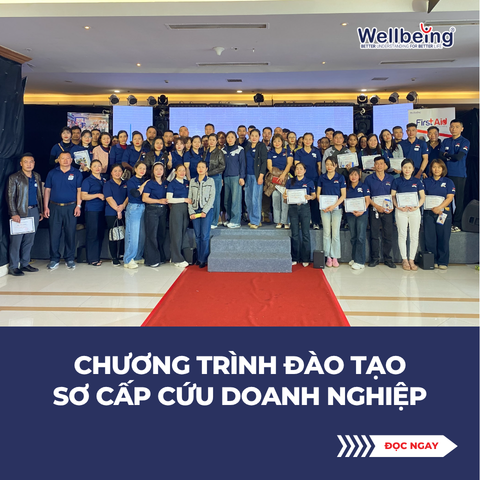
Based on its professional foundation and training methodology, Wellbeing deploys the corporate first aid training program in a flexible, realistic manner, focusing on applicability.
Corporate first aid training program at Wellbeing
Regarding the target audience, the program is designed for all personnel in the business, from management staff to employees. This aligns with the requirement to build an on-site first aid force according to legal regulations.
Regarding duration, businesses can choose training frames of 3 hours, 6 hours, or 8 hours depending on the required depth. The training is organized directly at the company, helping trainees practice right in their actual work environment.
At Wellbeing's corporate first aid training program, trainees do not just listen to lectures but directly practice each skill under the guidance of doctors, combined with highly realistic simulated situations. This helps detect and correct errors right during the learning process, increasing memory retention and reflexes when an incident occurs.
Regarding the corporate first aid training content, the program focuses on common workplace situations, including:
-
Basic principles of first aid and victim assessment
-
Cardiopulmonary Resuscitation (CPR) skills
-
Handling stroke and cardiac arrest
-
First aid for electric shock
-
First aid for bleeding and wounds
-
Immobilization of bone fractures
-
Safe victim transport techniques
These contents can be adjusted according to industry characteristics to ensure they suit the specific work environment of each business. After completing the course, trainees are issued a certificate in accordance with the regulations of the Ministry of Health and the Ministry of Labour, Invalids and Social Affairs, which is valid for use in the enterprise's occupational safety system.
In addition, the program limits the number of trainees in each class to ensure everyone receives adequate guidance. This is an important factor because corporate first aid training requires high precision in every action and cannot be deployed using a mass training model.
Corporate first aid training is a strategic investment decision in the risk management and occupational safety system of every organization. By complying with legal requirements and establishing highly applicable corporate first aid training content, organizations will maximize the benefits of corporate first aid training in protecting their human resources. The companionship of professional medical training units that provide systematic corporate first aid training programs like Wellbeing will equip workers with practical response capabilities, thereby establishing a standard, safe, and sustainably developing work environment.
Comments:
There are no comment for this news.

.png)
.png)