 Tiếng anh
 Vietnam
Engaging First Aid Workshop: Hands-on Practical Experience with Wellbeing
In modern living and working environments, emergencies such as fainting, choking, strokes, or occupational accidents can happen at any time. In such moments, a fast, correct, and effective response is the deciding factor in protecting the victim's life. Participating in a First Aid Workshop at Wellbeing not only equips you with knowledge but also allows you to directly practice crucial skills under the guidance of experienced doctors.
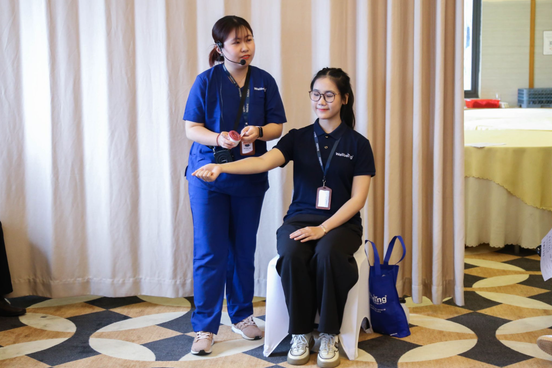
Trainees experience hands-on practice, boosting their confidence when participating in the First Aid Workshop.
1. What Makes Wellbeing's First Aid Workshop Special?
Unlike theory-heavy courses, the First Aid Workshop at Wellbeing is designed to be interactive, with a core focus on hands-on practice. Trainees don't just "listen" but "do" through realistic simulated scenarios.
The program is suitable for various audiences, including individuals, office workers, businesses, schools, and community organizations. With a flexible duration of 60 to 90 minutes, the workshop can be held right at the corporate office or at the Wellbeing center, ensuring convenience and an optimized learning experience.
The standout feature is that every trainee receives detailed instructions and practices directly on standard mannequins, thereby enhancing memory retention and reflexes in real-life situations.
2. Outstanding Content in the First Aid Workshop
The workshop is designed with a "learner-centric" philosophy, dedicating over 70% of the time to hands-on practice. This is vital because first aid is a reflex skill, not just theoretical memorization. Trainees will be equipped with knowledge on emergency safety principles, including scene assessment, protecting oneself and the victim, and standard procedures for calling for help.
Trainees will engage in realistic simulated scenarios such as:
-
A person fainting in the workplace.
-
A victim choking on a foreign object or having difficulty breathing.
-
Suspected stroke cases.
-
Trauma incidents involving bleeding or bone fractures.
The practical portion focuses on essential skills like Cardiopulmonary Resuscitation (CPR), handling choking, and first aid for bleeding, burns, electric shock, and bone immobilization. Notably, stroke recognition and first aid are explored in-depth, helping trainees spot early signs (facial drooping, limb weakness, speech disorders) to take timely action during the "golden window."
In addition to technical techniques, the workshop teaches soft skills in emergencies, such as communication, reassuring the victim, and teamwork. Furthermore, Wellbeing uniquely integrates ergonomics into the curriculum. Trainees learn how to adjust their working posture and arrange their workspace to prevent musculoskeletal injuries and occupational health issues, offering a comprehensive approach that ensures readiness for incidents while proactively minimizing risks from the start.
3. Why Should Businesses Organize a First Aid Workshop?
Implementing a First Aid Workshop is not just a training activity but an investment strategy for the safety and sustainable development of a business.
-
Risk Mitigation: It helps employees identify potential risks in the work environment and know how to handle incidents when they occur. This contributes to minimizing accident severity, increasing the chance of saving lives, and limiting injuries.
-
Team Building: The workshop creates an opportunity for team members to coordinate and practice in groups, thereby enhancing team spirit and the ability to work together under high pressure. This is a crucial element in building an internal safety culture and cohesion.
-
Humane Corporate Culture: When employees are equipped with life-saving skills, they not only work more effectively but also feel cared for and protected by their employer.
-
Life Skills: These skills extend beyond the workplace; they can be applied in daily life, enabling individuals to confidently support their loved ones and the community when necessary.
4. Community Value and Practical Benefits
Participating in a First Aid Workshop brings practical value to both personal life and the broader community.
-
For individuals: The workshop equips crucial skills to quickly identify dangerous situations, allowing for timely and correct reactions in the first few minutes—the "golden window" that determines survival and recovery. It also builds calmness, confidence, and real-life situational handling capabilities.
-
For the community: Popularizing skills through First Aid Workshops helps shorten the initial response time during an incident. When more people know how to administer correct first aid, victims' chances of survival improve significantly, while also reducing the burden on the healthcare system.
In a modern society with many hidden risks, participating in a First Aid Workshop is a necessary and long-term investment. Choosing a reputable training unit like Wellbeing not only helps trainees master the knowledge but also become proficient in practical skills through realistic simulations. This is not just personal preparation; it is a practical action contributing to building a safer, more proactive, and humane living environment.
Comments:
There are no comment for this news.

.png)
.png)