 Tiếng anh
 Vietnam
First Aid Procedures in Schools
In the educational environment, where students spend most of their time learning and participating in activities, accidents and health incidents can happen at any time. Therefore, establishing first aid procedures in schools is not only a professional requirement but also a crucial pillar of the school health system, contributing to protecting the safety and health of students.
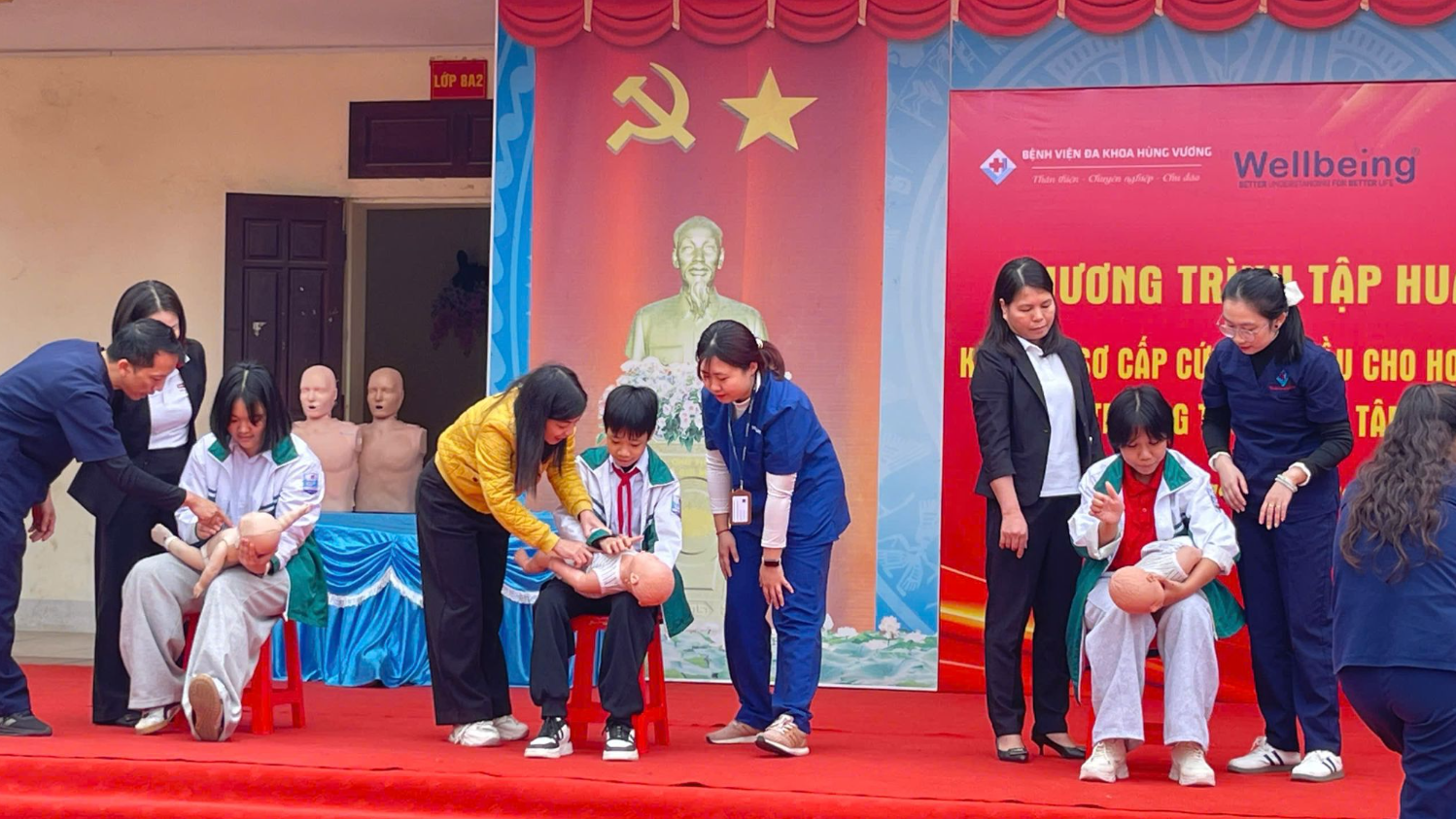
Guidelines for initial first aid for common injuries and accidents in children and students.
1. Standardizing First Aid Procedures in the School Health System
Following the orientation from the Ministry of Education and Training, the document "Guidelines for initial first aid for common injuries and accidents in children and students" was issued to standardize knowledge and skills for school health staff. This is an important basis to help schools build a unified, scientific, and easy-to-apply response procedure.
The document was developed in collaboration with the National Children's Hospital, updating modern pediatric emergency knowledge. It includes two main parts: initial first aid and handling common injuries such as choking, falls, electric shock, burns, drowning, or poisoning. This shows that first aid procedures in school health are not merely theoretical but closely tied to practice.
2. First Aid Procedures in Schools: Core Steps to Master
Approaching school health emergencies: The "4-step" principle to master
In the school health environment, emergency health situations such as stroke, choking on foreign objects, unconsciousness, or cardiac arrest can occur unexpectedly during class, recess, or extracurricular activities. A specific characteristic of schools is that the first responders are usually not medical staff, but surrounding teachers or students. Therefore, a clear, easy-to-remember, and easy-to-implement approach procedure is the factor that helps minimize panic and increase the ability to respond correctly during the "golden window".
Based on practical guidelines from Wellbeing, the procedure for approaching health emergencies in school health can be standardized into the following 4 core steps:
Step 1: Assess scene safety
Before assisting the victim, the responder needs to quickly observe the surrounding space to identify potential hazards such as power sources, crowded areas, sharp objects, or the risk of collision. In a school context, especially on sports fields, corridors, or laboratory areas, ensuring scene safety not only protects the first aider but also prevents the situation from becoming more serious.
Step 2: Check the victim's vital signs
After ensuring safety, it is necessary to quickly assess the victim's condition through three basic factors: consciousness (conscious or not), breathing (normal, weak, or stopped), and pulse. This is a crucial step in school health, helping to determine the level of urgency and direct subsequent actions, especially in critical situations like cardiac arrest or unconsciousness.
Step 3: Activate the support system
In a school environment, calling for help must be done in parallel with the initial assessment. Teachers or students need to quickly notify the school medical department and contact 115 emergency services when necessary. Activating support early helps maximize the "golden window" and increases the effective coordination between the school and medical facilities.
Step 4: Perform appropriate first aid and monitor continuously
Based on the victim's specific condition, the responder administers first aid measures within their trained skills, such as cardiopulmonary resuscitation (CPR), handling choking, stopping bleeding, or placing the victim in a recovery position (safe posture). Throughout this process, continuous monitoring of the victim's condition is required until professional help from medical personnel arrives.
3. Linking First Aid Procedures with Practical School Accidents
An important point in school first aid procedures is that they must be suitable for common situations. Reality shows that students are prone to accidents such as falls during physical education, choking while eating, burns from thermal contact, or even electrical accidents.
Therefore, first aid procedures cannot be generic but need to be specified for each situation. For example, in the case of choking, the Heimlich maneuver must be applied correctly; for burns, immediate cooling with clean water is required; for electric shocks, the power source must be turned off before approaching the victim. These skills need to be systematically trained within the school health system to ensure accuracy and safety.
4. The Role of Training and Drills in School Health
The procedures only truly become effective when the executors are fully trained. According to regulations, first aid materials have been deployed to train teachers, officials, and school medical staff nationwide. This helps enhance the capacity to handle emergency situations right at the school, reducing complete reliance on external medical facilities.
Periodic training not only helps consolidate knowledge but also hones reflexes and calmness when handling real-life situations. This is a crucial factor because, in emergency care, even a small mistake can affect a student's life.
5. Enhancing School Health Effectiveness Through Investment and Coordination
For first aid procedures to operate effectively, the school health system needs synchronized investment in facilities and equipment. The medical room must be fully equipped with first aid kits, essential medicines, and professionally trained personnel.
Besides, coordination between the school, families, and local health authorities also plays an important role. With close links, handling emergencies will be faster and more effective, while also contributing to raising community awareness about school safety.
6. Solutions to Enhance School Health Effectiveness from Wellbeing
For school first aid procedures to be implemented effectively, human and equipment factors need to be invested in synchronously. This is also the gap that many school health facilities currently face: a lack of practical skills and a lack of standard equipment to handle emergency situations promptly.
Wellbeing provides comprehensive solutions for school health, including first aid training services and equipping essential medical devices. The training programs are tailored for teachers, staff, and school medical personnel, adhering closely to the Ministry of Education and Training's guidelines. They combine theory with hands-on practice such as cardiopulmonary resuscitation (CPR), handling choking on foreign objects, trauma first aid, and recognizing and managing strokes.
Not stopping at training, Wellbeing also provides important school health equipment such as AED machines (automated external defibrillators) and standard first aid kits. These are tools that play a decisive role in the "golden window", especially in situations of cardiac arrest or severe accidents in schools.
Combining systematic training and adequate equipment helps schools build a proactive school health system, ready to respond to any situation. Simultaneously, this also contributes to elevating the school's professional and responsible image in protecting student health.
In the context of increasingly high requirements for school safety, choosing synchronized solutions from Wellbeing not only helps perfect first aid procedures but also creates a sustainable foundation for the development of a modern and effective school health system.
Comments:
There are no comment for this news.

.png)
.png)