 Tiếng anh
 Vietnam
How Many AEDs Does a Company With 300 Employees Need?
How many AEDs should a company with 300 employees have? Discover how to determine the right number of AEDs based on facility size, response time, and workplace layout.
A company with 300 employees should not determine the number of AEDs (Automated External Defibrillators) required based solely on the number of employees. The appropriate number of AEDs should be determined by factors such as facility size, building layout, number of floors, and actual emergency response time. According to the American Heart Association (AHA), the goal is for a victim to receive an AED shock within 3–5 minutes after sudden cardiac arrest occurs. For a single-floor office with an open layout and short travel distances, one centrally located AED may be sufficient. However, for multi-story buildings or facilities with separate areas such as gyms, cafeterias, or parking areas, at least one AED per floor or additional devices in higher-risk locations may be needed. A practical walk-through test is the most accurate way to determine the appropriate number and placement of AEDs for a workplace.
1.Why should a company with 300 employees not determine the number of AEDs based only on the number of employees?
The number of employees is an important factor to consider, but it is not the only criterion for determining how many AEDs a company needs. Two companies with the same number of employees may require completely different numbers of AEDs depending on their facility layout and operational characteristics. Consider the following two examples:
Company A has 300 employees working in a large, single-floor office. The AED is placed in a central, highly visible location, is not locked, and can be quickly accessed by employees from most areas of the workplace. In this case, one AED may be sufficient if practical emergency drills show that responders can retrieve the device and bring it to the scene within an appropriate response time.
Meanwhile, Company B also has 300 employees but operates in a six-story building with large meeting rooms, dining areas, a fitness room, and a separate parking area. If only one AED is placed on the ground floor, employees on upper floors or in distant areas may spend significant time locating and bringing the device to the victim.
The key difference is not the number of 300 employees, but how quickly an AED can be accessed when sudden cardiac arrest occurs. A company with a centralized workplace layout may require a different AED placement strategy compared with a company operating across multiple floors or separated areas. Therefore, the number of AEDs should be determined after evaluating the actual facility layout, AED locations, travel time from the cardiac arrest location to the AED, and the ability to bring the device to the emergency scene quickly.
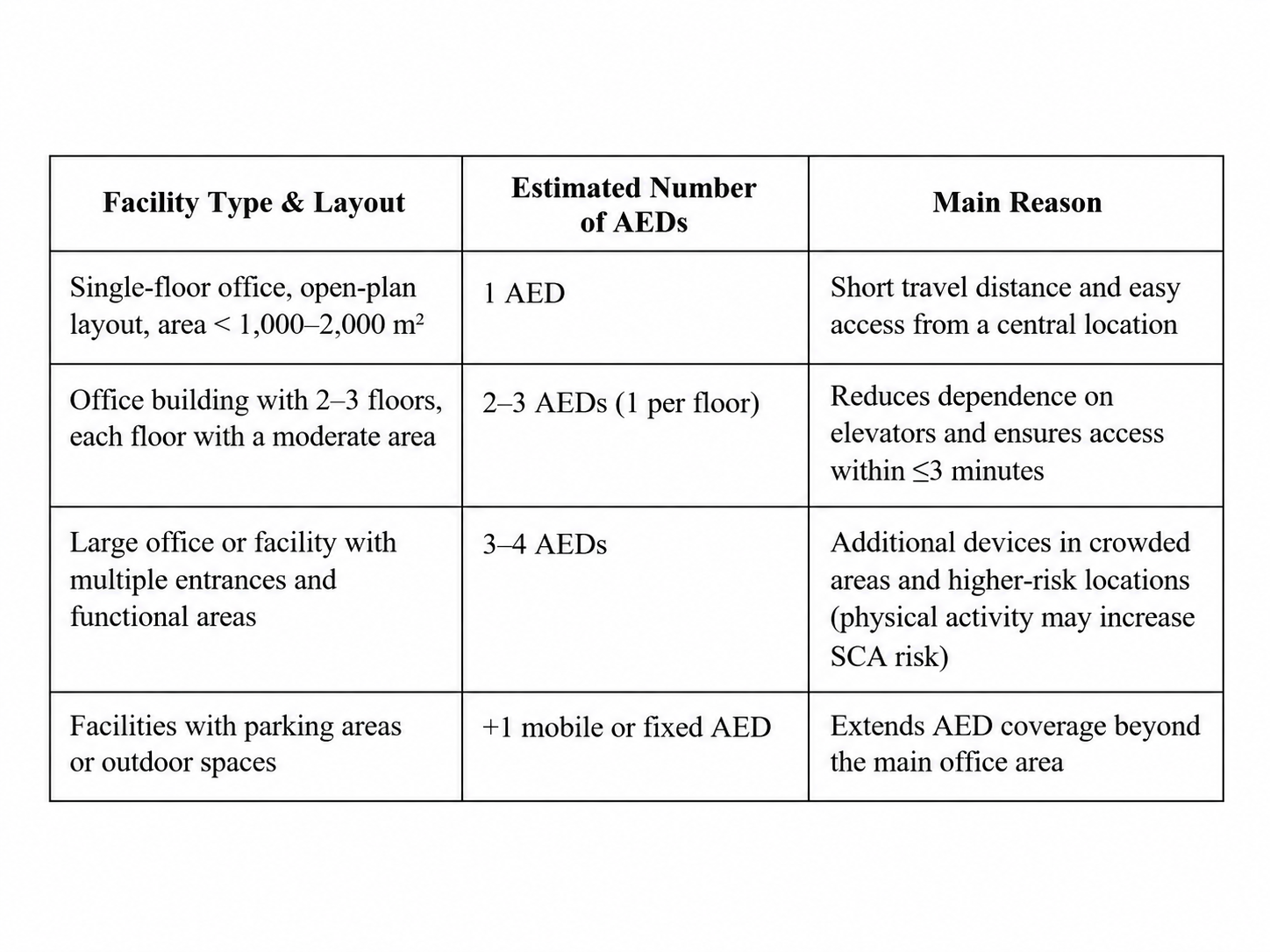 Image caption: The number of AEDs required for a company with 300 employees should be determined based on facility size and response time, rather than simply the number of employees.
2. How Can the Number of AEDs Be Determined Based on Access Time?
There is no single number of AEDs that applies to every company with 300 employees. However, businesses can use the principle of “coverage based on access time” to determine the appropriate number of AEDs required. The assessment process follows guidance from the American Heart Association and AED implementation organizations:
- Step 1: Identify the planned AED locations (such as central hallways, areas near elevators, or break rooms).
- Step 2: Walk from the furthest possible location where sudden cardiac arrest (SCA) could occur, such as an office corner, another floor, or a parking area, to the AED location at a fast walking pace.
- Step 3: Record the one-way travel time and multiply it by two to calculate the round-trip time (retrieving the AED and bringing it back to the emergency scene).
- If the travel time exceeds 3 minutes (or more than approximately 1.5–2.5 minutes one way), additional AEDs should be considered.
This assessment should be repeated across different areas of the facility, taking into account peak working hours, stairways, locked doors, elevators, and other potential obstacles. The goal is to ensure that every location within the facility can be reached within a 3–5 minute response window.
3.How Many AEDs Does a Company Typically Need Based on Real-World Examples?
The following table provides a reference based on response time principles and practical AED implementation experience:
|
Facility Type & Layout |
Estimated Number of AEDs |
Main Reason |
|
Single-floor office, open-plan layout, area < 1,000–2,000 m² |
1 AED |
Short travel distance and easy access from a central location |
|
Office building with 2–3 floors, each floor with a moderate area |
2–3 AEDs (1 per floor) |
Reduces dependence on elevators and ensures access within ≤3 minutes |
|
Large office or facility with multiple entrances and functional areas |
3–4 AEDs |
Additional devices in crowded areas and higher-risk locations (physical activity may increase SCA risk) |
|
Facilities with parking areas or outdoor spaces |
+1 mobile or fixed AED |
Extends AED coverage beyond the main office area |
Some references suggest a ratio of 1 AED per 1,000–2,000 m²; however, practical response testing should always be prioritized.
A company with 300 employees is considered a medium-sized organization. In many cases, 1–3 AEDs may be appropriate if the devices are positioned strategically and the response time is ensured.
4. What Factors Affect the Number of AEDs a Company Needs?
There are at least four key factors that businesses should consider when determining the appropriate number and placement of AEDs.
First is the facility layout and coverage area. Having one AED located on the ground floor does not necessarily mean that employees on all floors can access the device quickly.
Second is the actual travel time. The distance shown on a building plan does not always reflect the real response time. Factors such as stairways, access-controlled doors, elevators, hallways, restricted areas, and crowd density can all affect how quickly an AED can be delivered to the victim.
Third is the nature of business operations. Factories, construction sites, warehouses, sports centers, hotels, and offices each have different risk profiles and workforce arrangements.
Fourth is the organization’s emergency response capability. Even when an AED is placed in an appropriate location, its effectiveness may be limited if no one knows how to recognize cardiac arrest, call for emergency assistance, perform CPR, and use the device correctly.
5. Why Is AED Access Time More Important Than the Number of Employees?
During a sudden cardiac arrest emergency, an AED should be delivered to the victim as quickly as possible when the device is available and defibrillation is indicated.Therefore, AED deployment should focus on practical accessibility rather than simply the total number of devices installed.
A simple example can help illustrate this point: magine an employee experiences cardiac arrest in a production area. The AED is stored in the administrative office on the first floor. A bystander must run to the office, retrieve the device, return to the production area, and only then begin using it. In this situation, although the company technically “has an AED,” the device location may not be optimal.
On the other hand, if an AED is placed in a clearly visible and easily accessible location with proper signage, one responder can quickly bring the device to the scene while another person performs CPR. The value of an AED therefore depends not only on having the equipment but also on how effectively the organization deploys and manages it.
The American Heart Association and international resuscitation guidelines emphasize the importance of early CPR and early defibrillation in the management of cardiac arrest. Businesses should develop response plans that allow these actions to happen simultaneously rather than waiting for one step to be completed before starting the next.
6. Where Should a Company Place AEDs?
AED locations should prioritize quick access, clear visibility, and minimal barriers during an emergency. The best location is not necessarily the place where the most people can see the device, but the place that allows responders to quickly retrieve the AED and bring it to the emergency scene. Businesses should consider locations such as:
- Main entrances and reception areas
- High-traffic areas
- Production areas
- Sports facilities
- Dining areas
- Workspaces with high employee density
- Areas located far from other sections of the facility
For businesses operating across multiple floors, special attention should be given to accessibility between floors. If only one AED is available, the organization should clearly determine where it will be placed and how employees in other areas can access it quickly when needed.
A medical room may be convenient for equipment management; however, if the room is locked or accessible only to certain individuals, it may increase the time required to retrieve the AED. For workplace AED programs, rapid and continuous accessibility should be considered together with equipment security, storage conditions, and management requirements.
If an AED cabinet is used, businesses should select a location that is easy to identify, ensure the device can be retrieved quickly when needed, provide appropriate signage, and establish procedures so employees know how to access the AED during an emergency.
7. How Should an AED Be Used Together With CPR?
An AED does not replace CPR. When a person is found with abnormal breathing, bystanders should call for emergency medical assistance and begin CPR based on their training, while also retrieving an AED if one is available.
When the AED arrives, the responder should turn on the device, attach the AED pads to the victim’s chest according to the device instructions, and follow the voice or visual guidance provided by the AED.
The AED will analyze the heart rhythm. The responder must follow the device instructions and must not touch the victim during the analysis process or while the device is preparing to deliver or delivering a shock, as instructed.
After the AED delivers a shock or determines that no shock is required, the responder should continue CPR according to the AED instructions and guidance from the emergency response system until signs of recovery appear or professional medical personnel take over.
This demonstrates that CPR training and AED training should always be combined as part of an organization’s AED implementation plan.
8.FAQ: Frequently Asked Questions About the Number of AEDs in Businesses
8.1. Is a company with 300 employees required to purchase an AED?
This cannot be determined based solely on the number of 300 employees. Businesses need to consider applicable legal requirements for their industry, operating conditions, and facility characteristics, while also assessing their actual emergency response needs.
8.2. Can a company with 300 employees purchase only one AED?
It may be suitable for some organizations with a centralized layout, but the decision should not be based only on the number of employees. The ability to access the AED from different working areas should be evaluated.
8.3. Should an AED be placed in the medical room?
It is possible, but it is not always the optimal location. If the medical room is locked or difficult to access, retrieving the device may take longer. AED placement should prioritize quick and convenient access.
8.4. Can employees who have not received CPR training use an AED?
AEDs are designed to guide users through voice prompts, visual instructions, or device guidance depending on the model. However, CPR and AED training remain very important to help responders recognize the situation and coordinate the response correctly.
8.5. Does an AED replace medical personnel?
No. An AED is an initial emergency response device and does not replace professional emergency medical systems. When cardiac arrest occurs, the emergency response system must be activated while appropriate resuscitation measures are performed.
8.6. Should a company choose an automatic or semi-automatic AED?
There is no single type of AED that is best for every business. The decision should be based on the intended user group, level of training, deployment environment, manufacturer’s instructions, and equipment management requirements.
9. Conclusion
Providing an AED is only one part of a sudden cardiac arrest response system. For the device to be effective during an emergency, it is also necessary to equip people who may be the first to reach the victim with the appropriate knowledge and skills.
AED training programs help participants understand how the device works, recognize signs of cardiac arrest, perform CPR (cardiopulmonary resuscitation), and coordinate AED use according to the correct procedure.
In addition, practicing simulated emergency scenarios helps learners reduce hesitation and become more confident when intervention is needed before professional medical personnel arrive.
Wellbeing provides an integrated solution that combines AED equipment with comprehensive CPR–AED training, including both theoretical knowledge and practical skills. This helps organizations build a proactive response system where equipment is always ready, users are properly trained, and procedures are regularly reviewed.
The training program combines concise theoretical instruction with hands-on practice using training models and real equipment, including skills in victim assessment, AED pad application, ensuring safety while the device analyzes the heart rhythm and delivers a shock, team coordination, and communication during emergency situations.
Comments:
There are no comment for this news.

.png)
.png)