 Tiếng anh
 Vietnam
Mandatory Fire Safety Regulations for Businesses Under Vietnamese Law
In the context of numerous fires and explosions causing severe damage to life and property, fire prevention and fighting (FPF) safety is not only a legal requirement but also a mandatory responsibility for every business. From July 1, 2025, a series of new regulations on fire prevention, fighting, and rescue operations will officially take effect, tightening management and elevating the responsibilities of the heads of production and business facilities.
So, what fire safety regulations must businesses comply with? Does the reduction of administrative procedures compromise safety requirements? The article below will help provide a clear understanding.
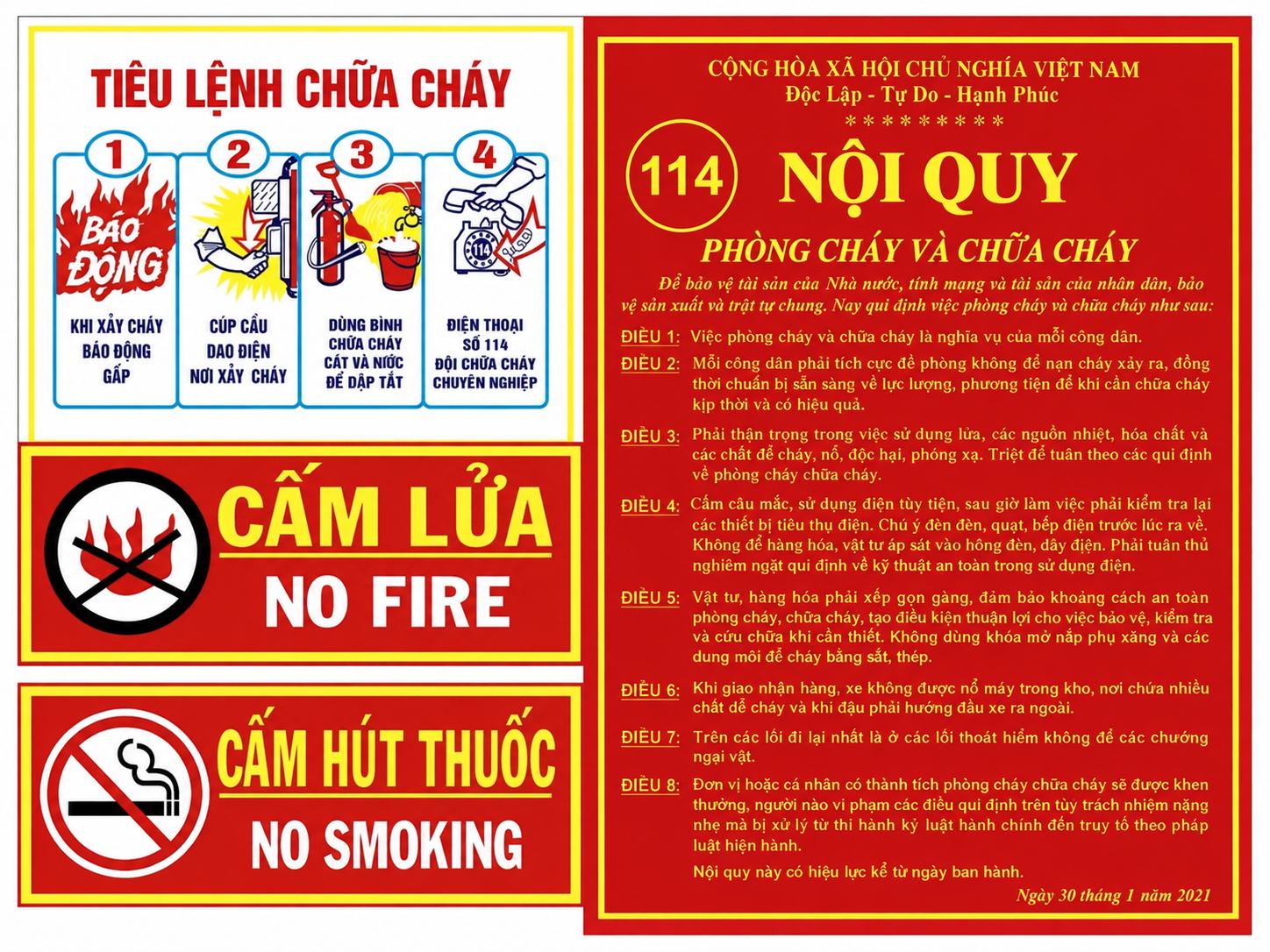
Fire safety rules and instruction boards must be posted at business premises to help employees strictly adhere to regulations and respond promptly in the event of a fire or explosion.
1. Legal Context and Goals for Tightening Fire Prevention and Fighting (FPF) Safety
In recent years, the Government has promoted administrative reform in the field of Fire Prevention and Fighting (FPF) to reduce the burden on businesses while maintaining a strict legal framework.
From July 1, 2025, Decree No. 105/2025/ND-CP, which provides detailed regulations on several provisions and implementation measures of the Law on Fire Prevention, Fire Fighting, and Rescue, officially came into effect.
The new Decree sets out specific regulations on the list of facilities subject to FPF management, internal rules, documentation, inspections, training, emergency plan drills, design appraisal, acceptance procedures, compulsory fire and explosion insurance, and FPF data connectivity.
From the effective date of Decree No. 105/2025/ND-CP, Decree No. 83/2017/ND-CP, Decree No. 136/2020/ND-CP, and Decree No. 50/2024/ND-CP cease to be effective, except for transitional cases specifically provided for.
Under these regulations, the head of the enterprise must organize the implementation and maintenance of FPF safety conditions, develop firefighting plans, conduct professional training, and perform periodic self-inspections. Simultaneously, businesses must comply with Vietnamese Standards (TCVN) and National Technical Regulations (QCVN) on fire and explosion safety in the design, construction, and operation of their facilities.
Therefore, administrative procedure reform does not mean that safety standards are being relaxed. Responsibilities for self-inspection, self-assessment, and legal accountability in Fire Prevention and Fighting (FPF) remain clearly regulated, with strict penalties applicable in cases of violation.
What should FPF internal rules include?
Under current regulations, the FPF and rescue internal rules of a facility should include basic provisions on:
- Management and use of electricity, ignition sources, heat sources, equipment that may generate fire or heat, and flammable or explosive substances.
- Management and use of FPF and rescue equipment.
- Actions that must be taken in the event of fire, explosion, accident, or other emergency.
The internal rules must be appropriate to the facility’s operations, communicated to relevant personnel, and posted in a clearly visible location.
2. Mandatory FPF Regulations Businesses Must Comply With
2.1. Fire Safety Design Approval and Acceptance
Under current regulations, buildings that fall within the list of facilities with fire and explosion hazards must:
- Complete FPF design appraisal before construction.
- Complete FPF acceptance procedures before being put into operation.
- Ensure that fire alarm systems, firefighting systems, and evacuation routes meet applicable technical standards.
Businesses should pay particular attention to FPF requirements when:
- Constructing new buildings.
- Renovating or repairing existing buildings.
- Expanding the scale of operations.
- Changing the function or use of a building.
- Modifying designs in ways that affect FPF solutions.
Not all buildings are subject to the same procedures. Businesses therefore need to compare the type and scale of their facility against the applicable lists under current regulations. Certain smaller projects may be decentralized to local authorities for processing in order to shorten administrative timelines, but they must still fully meet Fire Prevention and Fighting (FPF) safety standards.
2.2. FPF management records of the business
Instead of focusing only on a particular license or certificate, businesses need to pay attention to the overall system of FPF and rescue management records maintained at the facility.
Depending on the type of facility and the applicable requirements, the records may include:
- Facility information form.
- FPF and rescue internal rules.
- FPF design appraisal and acceptance records, where applicable.
- Decision establishing the facility’s FPF and rescue team, or written assignment of responsible personnel.
- Documents relating to professional training.
- Firefighting and rescue plans.
- FPF and rescue equipment monitoring log.
- FPF self-inspection records.
- Reports on the implementation of FPF and rescue activities.
- Compulsory fire and explosion insurance certificate, where required.
- Inspection, recommendation, or violation-handling records, if any.
Certain records must be retained for the minimum period prescribed by law, including documents that must be kept for at least five years from the year in which they are prepared or issued.
2.3. Periodic Inspection and Maintenance of FPF Systems
The head of the facility is responsible for organizing regular and periodic self-inspections of Fire Prevention and Fighting (FPF) activities in order to promptly identify and address safety risks at the facility.
For regular self-inspections, the results must be recorded at intervals of no more than one month. In addition, facilities must conduct periodic inspections according to the applicable category. Specifically, facilities listed in Appendix II must conduct inspections once every six months, while the remaining facilities listed in Appendix I must conduct inspections once a year.
During inspections, businesses should focus on important areas such as electrical systems and heat sources, fire extinguishers, fire alarm and firefighting systems, evacuation routes, FPF signs and internal rules, rescue equipment, and areas with potential fire or explosion risks.
It is important to distinguish between a facility’s self-inspection and inspections conducted by government authorities. The Police and other competent management authorities conduct inspections according to separate legal provisions concerning scope, frequency, and applicable conditions.
Alongside inspections, businesses should also perform periodic maintenance and servicing of FPF equipment and systems in accordance with the technical requirements of each device. This helps maintain stable operation and ensures that the equipment remains ready for use in an emergency.
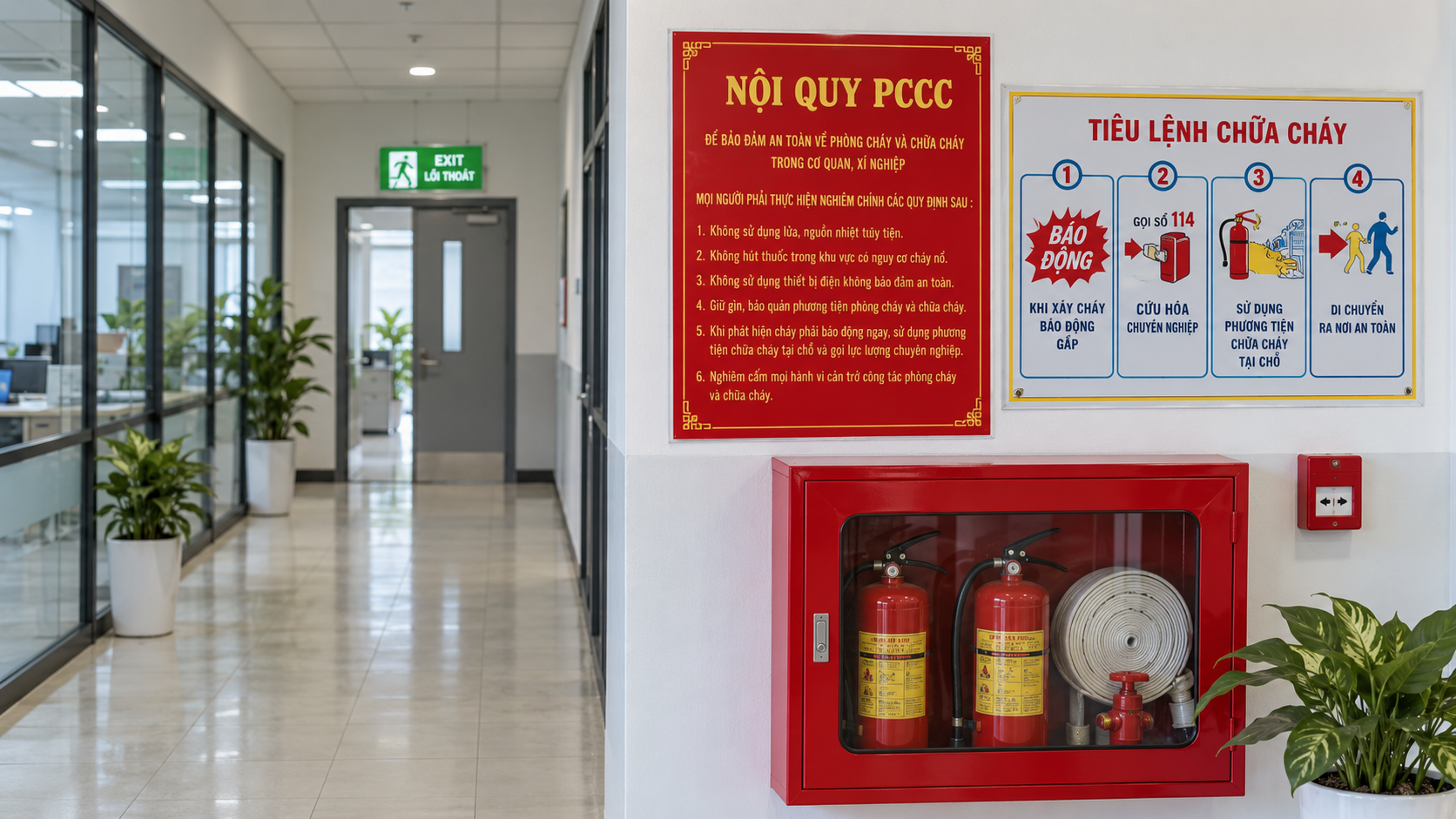
Illustration: Arrangement of FPF emergency instructions and regulations at a business.
2.4. Responsibilities of the Head of the Enterprise
One of the important aspects of Fire Prevention and Fighting (FPF) regulations is the responsibility of the head of the facility. The head of the facility is not only responsible for organizing and maintaining FPF safety conditions, but must also proactively manage documentation, equipment, personnel, and emergency response plans.
The head of the facility is responsible for:
- Issuing or advising on the issuance of FPF and rescue internal rules, communicating them, and posting them at the facility.
- Establishing, managing, and updating FPF records in accordance with regulations.
- Organizing self-inspections and promptly addressing identified safety risks.
- Providing and maintaining FPF equipment and systems in a ready-to-use condition.
- Ensuring that evacuation routes are appropriately arranged and that emergency exits are not locked or obstructed.
- Organizing FPF and rescue training and refresher training for relevant groups in accordance with regulations.
- Organizing drills for firefighting and rescue plans. For facilities subject to this requirement, such plans must be practiced at least once a year.
Failure to perform or fully comply with FPF responsibilities may result in legal action depending on the nature and severity of the violation.
2.5. FPF training and refresher training for personnel
Businesses need to correctly identify the groups of employees who are required to participate in professional Fire Prevention and Fighting and Rescue training, rather than applying the same program to all employees. Depending on the position, responsibilities, and level of involvement in FPF activities, the duration and content of training may vary.
Under current regulations, professional FPF and rescue training is conducted periodically once every five years, while refresher training is organized annually to update knowledge, reinforce skills, and maintain emergency response capability.
Training should be linked to realistic situations at the facility so that employees not only understand the regulations but also know how to respond, coordinate with others, and use appropriate FPF equipment in an emergency.
3. Notable Changes from July 1, 2025
The new regulations place greater emphasis on proactive FPF management at the facility. Some notable points include:
- More clearly defining the responsibilities of the head of the facility.
- Providing clearer requirements for internal rules and FPF management records.
- Requiring regular self-inspection results to be recorded at intervals of no more than one month.
- Clearly specifying periodic inspection frequencies according to facility category.
- Requiring firefighting and rescue plans to be practiced at least once a year.
- Requiring professional training once every five years and refresher training annually.
- Strengthening reporting, updating, and connectivity of FPF data.
- Continuing to classify and address facilities that do not meet FPF requirements under transitional provisions.
Important dates businesses should note
- July 1, 2025: The 2024 Law on Fire Prevention, Fire Fighting, and Rescue and Decree No. 105/2025/ND-CP officially take effect.
- January 1, 2026: One of the milestones in the process of classifying, reviewing, and publishing the list of facilities subject to transitional FPF measures.
- July 1, 2026: Authorities responsible for specialized construction works are required to complete relevant technical solutions for buildings subject to transitional regulations.
- July 1, 2027: The head of a facility subject to FPF management under Appendix I must complete the installation and connection of fire alarm transmission equipment to the Fire Prevention, Fire Fighting, and Rescue Database and fire alarm transmission system.
- July 1, 2028: Certain facilities included in transitional lists published by provincial-level People’s Committees must complete the required corrective measures. If suitable technical solutions cannot be applied, the function of the facility must be changed in accordance with regulations.
These milestones do not apply in the same way to every business. Each business therefore needs to determine which category its facility falls under.
4. What Must Businesses Do to Ensure FPF Safety Compliance?
To fully comply with FPF legal requirements, businesses should:
- Regularly update legal regulations: Monitor new Decrees and Circulars issued by the Government and the Ministry of Public Security.
- Determine the correct management category: Businesses should check whether their facility falls under Appendix I, II, III, or VII in order to apply the corresponding FPF requirements correctly.
- Proactively conduct internal self-inspections: Establish periodic inspection procedures for electrical systems, firefighting systems, and evacuation routes.
- Complete and update FPF records: Records should include internal rules, firefighting plans, inspection records, training documents, and equipment monitoring logs.
- Organize FPF training and drills: Training should be appropriate for each group of personnel, while firefighting and rescue plans must be practiced in accordance with regulations.
- Check insurance obligations: If the facility falls within the category required to purchase compulsory fire and explosion insurance, the business must fully comply with this obligation.
- Prepare for fire alarm transmission connectivity: Facilities listed in Appendix I should prepare in advance to meet the connection requirement before July 1, 2027.
- Maintain FPF systems and equipment: Equipment should be inspected, maintained, and replaced promptly when expired or no longer capable of operating safely.
- Select suitable professional service providers: Businesses should work with competent organizations to select solutions, equipment, and materials that meet applicable standards, technical regulations, and building-specific requirements.
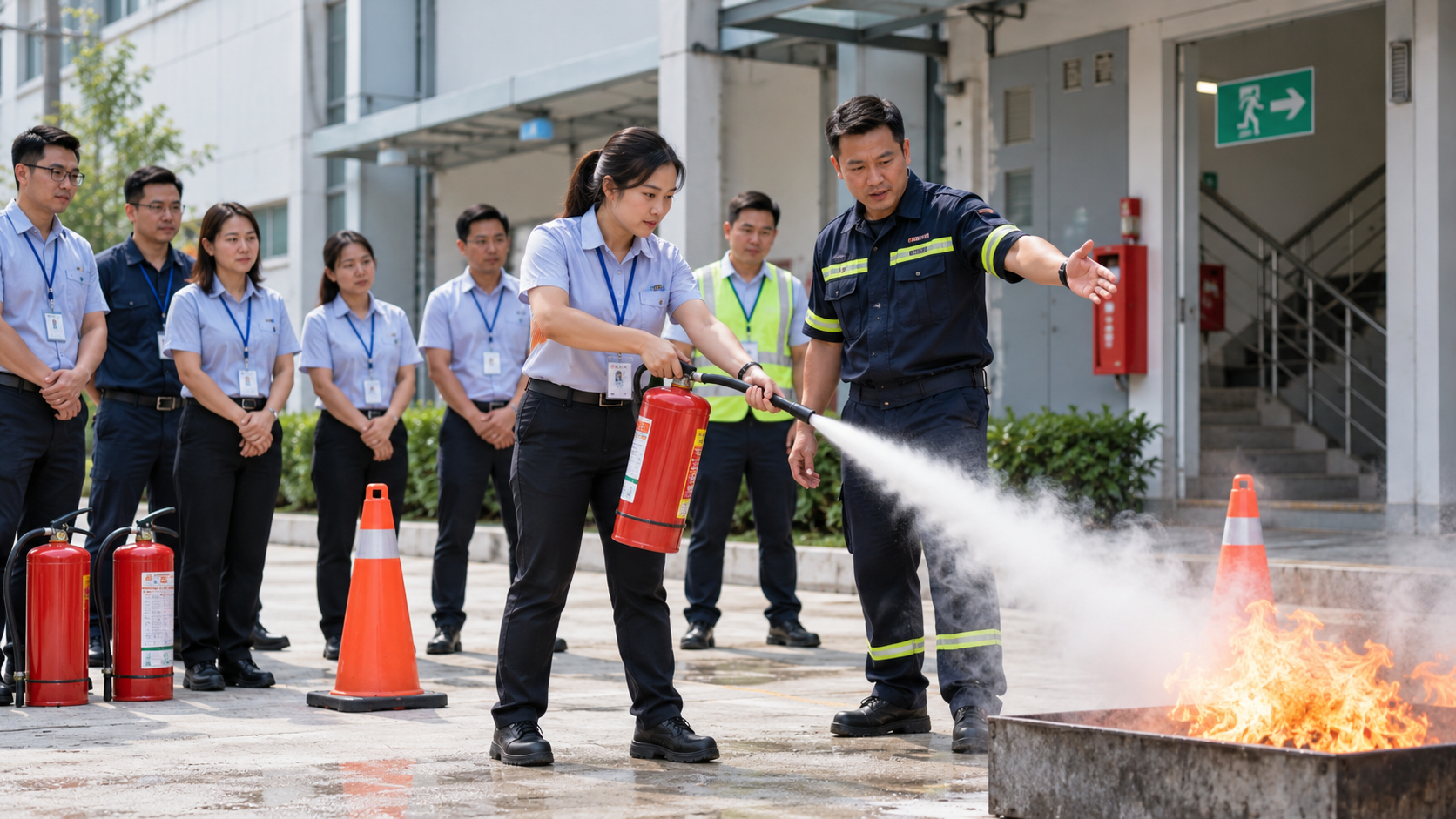 Illustration: Organizing FPF training for personnel in accordance with Fire Prevention and Fighting safety requirements.
5. The Role of Standard-Compliant FPF Materials and Equipment
One of the key factors in meeting Fire Prevention and Fighting (FPF) requirements is the quality of materials and the operational reliability of technical systems.
Depending on the characteristics of the building, the system may include:
- Fire-resistant panels, partitions, or structural components.
- Fire doors.
- Fire dampers.
- Fire alarm systems.
- Automatic firefighting systems.
- Pressurization and smoke extraction systems.
- Fire extinguishers and rescue equipment.
- Emergency lighting and evacuation signage.
Businesses need to select equipment and materials that comply with the standards, technical regulations, and technical requirements applicable to each building.
Not all equipment, devices, or materials are subject to the same regulatory mechanism. Certain categories are subject to licensing or other management requirements before being placed on the market, depending on the applicable legal list.
Therefore, businesses should pay attention to selecting suppliers with clear product documentation, complete technical records, and appropriate maintenance support.
6. Does administrative procedure reform reduce Fire Prevention and Fighting safety requirements?
Administrative procedure reform does not mean that businesses have fewer responsibilities in Fire Prevention and Fighting activities. On the contrary, the new legal framework places greater emphasis on the proactive role of the head of the facility in maintaining and controlling FPF safety conditions.
Accordingly, businesses need to regularly conduct self-inspections, manage and update records, train personnel, practice firefighting plans, maintain FPF equipment in a state of readiness, and monitor and promptly address risks that may lead to fire or explosion. For facilities subject to applicable requirements, updating and connecting FPF data must also be carried out in accordance with regulations.
The more proactive a business is in its management, the greater its ability to identify risks early and take timely corrective action, thereby reducing the likelihood of fire or explosion and minimizing damage if an emergency occurs.
Frequently Asked Questions
1. Are businesses required to conduct monthly FPF self-inspections?
The results of regular self-inspections must be recorded at intervals of no more than one month. In addition, periodic inspections may be required every six months or once a year depending on the category of the facility.
2. Are businesses required to conduct an FPF drill every year?
For facilities required to prepare firefighting and rescue plans, these plans must be practiced at least once a year.
3. Are all businesses required to purchase compulsory fire and explosion insurance?
No. This obligation applies only to facilities included in the list subject to compulsory fire and explosion insurance under applicable regulations.
4. Are all businesses required to connect fire alarm transmission equipment before July 1, 2027?
No. This requirement applies to facilities subject to FPF management under Appendix I.
5. Does a facility’s self-inspection replace inspection by competent authorities?
No. Self-inspection is the responsibility of the facility. Inspections conducted by the Police and other competent authorities are carried out under separate regulations.
Conclusion
From July 1, 2025, Fire Prevention and Fighting safety at businesses should be viewed as an ongoing management system, rather than simply the installation of fire extinguishers or preparation of documentation when an inspection is expected.
Businesses need to correctly determine the applicable requirements, maintain internal rules and records, conduct self-inspections, train personnel, practice emergency plans, and ensure that FPF equipment remains ready for use.
Proactive compliance not only helps businesses reduce legal risks, but more importantly protects people, property, business operations, and organizational reputation in emergency situations.
Note: The specific obligations of each business depend on its type, scale, nature of operations, and whether the facility falls within the categories listed in Appendix I, II, III, VII, or other relevant appendices of Decree No. 105/2025/ND-CP.
References
National Assembly of Vietnam (2024) Law No. 55/2024/QH15 – Law on Fire Prevention, Firefighting and Rescue, promulgated on 29 November 2024 and effective from 1 July 2025. Government Electronic Information Portal. Law No. 55/2024/QH15
Government of Vietnam (2025) Decree No. 105/2025/ND-CP dated 15 May 2025 detailing a number of articles and measures for implementing the Law on Fire Prevention, Firefighting and Rescue. Government Electronic Information Portal. Decree No. 105/2025
Government of Vietnam (2026) Decree No. 347/2026/ND-CP dated 8 September 2026 amending and supplementing a number of articles of Decree No. 105/2025/ND-CP and several related decrees. Government Electronic Information Portal. Decree No. 347/2026
Comments:
There are no comment for this news.

.png)
.png)