 Tiếng anh
 Vietnam
Should Apartment Buildings Have AEDs? Placement Guide
Should apartment buildings have AEDs? Learn where to install them, how many are needed, and how CPR and AED training improve resident safety.
Apartment buildings should consider installing automated external defibrillators (AEDs), particularly in residential communities with large populations and multiple shared facilities.
When determining AED placement in apartment buildings, the most important consideration is accessibility during a cardiac arrest emergency. Can residents easily locate and retrieve the device? Could elevators, emergency exits, or access-controlled doors delay retrieval? Are there residents or staff trained in cardiopulmonary resuscitation (CPR) and AED use?
The most suitable AED locations should be determined based on each building's layout, high-traffic areas, and daily activities.
AED placement in apartment buildings should prioritize rapid access, particularly in lobbies, sports facilities, and other high-traffic areas.
1. Why Should Apartment Buildings Have AEDs?
Installing an AED in an apartment building can be an important component of a residential community's cardiac arrest emergency response system, especially when combined with CPR training and emergency medical services activation.
Unlike in hospitals, the first person to discover someone experiencing cardiac arrest in an apartment building is often a family member, neighbor, security guard, maintenance worker, or nearby resident. During the first few critical minutes, these individuals may be the only people available to intervene before professional emergency medical services arrive.
An AED is designed to analyze the heart's rhythm through electrode pads placed on the chest and determine whether defibrillation is necessary. It is not simply a device that delivers an electrical shock to anyone who becomes unconscious. Instead, it helps rescuers remain calm and follow the appropriate steps.
The AED only delivers a shock when it detects a shockable heart rhythm, such as ventricular fibrillation. When a shock is not advised, the device can provide visual or audio instructions to help rescuers perform CPR.
Therefore, installing AEDs in apartment buildings should be viewed as part of a comprehensive community safety system, rather than simply purchasing another piece of medical equipment.
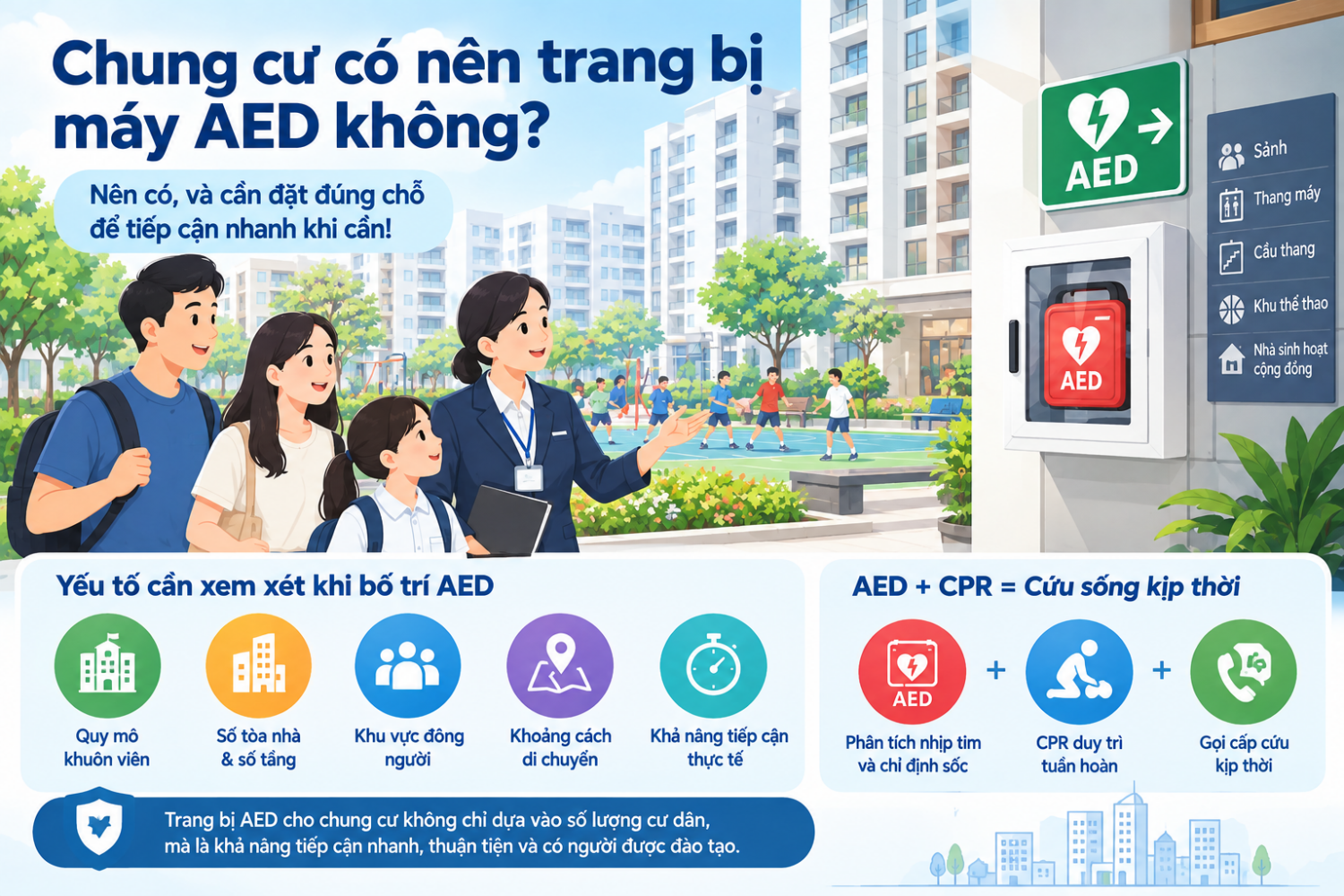
Illustration: AED placement in apartment buildings, particularly in lobbies, sports facilities, and high-traffic areas.
2. Do Apartment Buildings With More Residents Need More AEDs?
The number of residents is not the only factor determining how many AEDs an apartment complex needs. More importantly, building management should consider the area that needs to be covered and how quickly the device can reach someone experiencing cardiac arrest.
For example, a residential building with 1,000 residents and a relatively centralized layout will have different AED requirements from a residential complex consisting of 5–10 buildings, multiple basement levels, community rooms, sports facilities, and outdoor spaces.
If only one AED is installed in the main lobby, it may be highly visible but not necessarily accessible to residents on upper floors or in areas far from the lobby.
Conversely, installing numerous AEDs without assigning responsibility for equipment management, providing training, or monitoring device readiness does not guarantee an effective emergency response system.
The guiding principle should therefore be to evaluate AED accessibility before deciding how many devices to install.
Building management should consider the property's total area, number of floors, number of buildings, high-traffic locations, and actual travel routes between potential emergency locations and AED stations.
3. Where Should AEDs Be Installed in Apartment Buildings?
AEDs should be installed in visible, easily accessible locations that can serve a sufficiently large area of the residential community, rather than simply being stored wherever it is most convenient for building management.
The total time needed to reach the AED and return to the emergency location should be less than four minutes.
3.1. Sports and Recreational Facilities
AED installation should be considered in areas with high foot traffic or frequent physical activity.
Swimming pools, gyms, sports courts, community centers, and children's playgrounds may experience varying numbers of users throughout the day.
If these facilities are located far from the main lobby or security office, relying solely on a centrally located AED could increase the time required to retrieve the device.
This does not mean that every recreational facility must have its own AED. Instead, building management should evaluate each area's location, frequency of use, occupancy levels, and the routes required to deliver an AED to the emergency scene.
3.2. Security Offices or Medical Rooms
Security offices and medical rooms can be suitable AED locations, but only if the equipment can be retrieved quickly without restrictions related to operating hours or access permissions.
A security office offers the advantage of having staff who are often on duty and available to coordinate emergency response efforts.
However, problems may arise if the AED is kept in a locked room or if only one employee knows where the device is stored and how to access it.
Similarly, an apartment building's medical room or first-aid room may be suitable for equipment management but may not necessarily be the optimal location for the AED itself.
An effective AED location should balance equipment security, visibility, and rapid accessibility.
AED cabinets can protect the equipment and make it easier to identify. However, locking mechanisms and cabinet-opening procedures should be designed to avoid delaying rescuers during emergencies.
3.3. Main Lobbies and Reception Areas
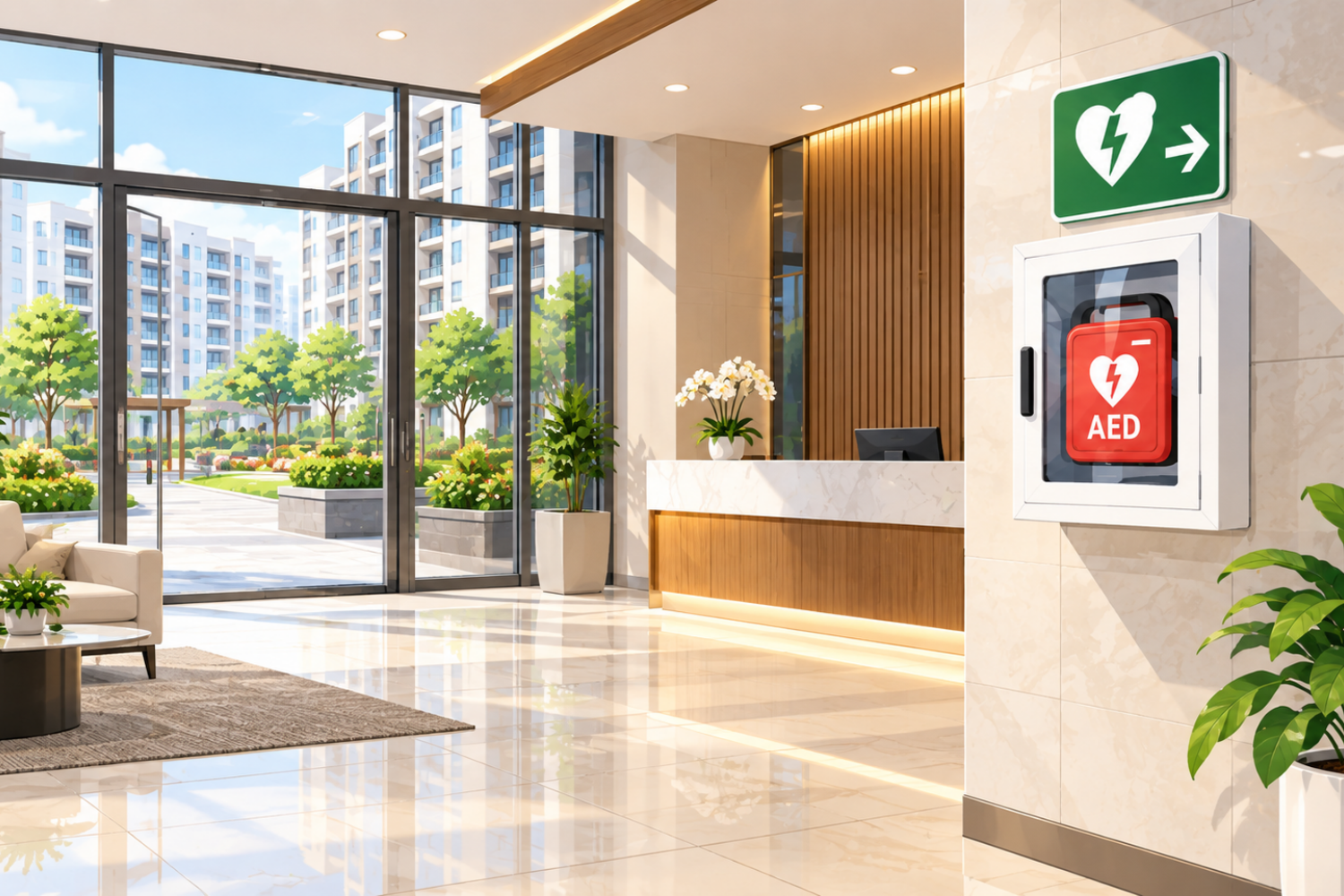
The main lobby is often a suitable AED location because it is highly visible and typically staffed by security personnel or receptionists. However, accessibility from other parts of the building must also be considered.
Residents regularly pass through the lobby, making an AED installed there easy to recognize. Visitors can also identify its location.
Security guards and reception staff are often present and can help people retrieve the AED or coordinate emergency response activities.
However, in high-rise apartment buildings where residential units are located far from the lobby, building managers should not automatically assume that one AED at the main entrance is sufficient.
Access routes from upper floors, recreational facilities, and other shared spaces should be evaluated carefully.
Illustration: AED placement in an apartment building's main lobby or reception area.
4. How Do Elevators Affect AED Accessibility in Apartment Buildings?
Elevators, staircases, emergency exits, and access-controlled doors should all be considered when planning AED placement, because distances shown on a building floor plan do not necessarily reflect actual travel times.
An AED might be located only a few dozen meters from an apartment in a straight line. However, retrieving it may require someone to pass through controlled-access doors, travel down to the lobby, wait for an elevator, or navigate long corridors.
During a cardiac emergency, these obstacles can significantly affect how quickly the AED reaches the patient.
When surveying an apartment building, management teams should therefore simulate actual retrieval routes from the most distant locations to the AED.
In multi-story buildings, particular attention should be paid to whether a rescuer can reach the device and return to the emergency scene without unnecessary delays.
This is also why the number of floors should not be used as a direct formula for determining AED quantities.
A high-rise building with efficient vertical transportation may have different AED placement needs from a building with multiple restricted-access areas.
5. Can Residents Without Medical Training Use an AED?
AEDs are designed to guide rescuers through the emergency response process. However, apartment residents and building staff should still receive first-aid training, including instruction on how to use an automated external defibrillator, so they can respond promptly during emergencies.
Modern AEDs can provide voice instructions, visual prompts, or both.
Users should follow the device's instructions step by step and observe all safety warnings. During heart rhythm analysis and shock delivery, no one should touch the patient, as instructed by the AED.
This is particularly important in apartment buildings, where medical professionals may not be immediately available.
Security guards, receptionists, maintenance technicians, and trained resident volunteers can serve as the initial emergency response team.
The purpose of training is not to turn residents into medical professionals. Instead, it is to help them recognize emergencies, call for assistance, begin CPR, retrieve an AED, and follow the device's instructions.
6. How Should Apartment Buildings Organize a Cardiac Arrest Response Team and Coordinate CPR With AED Use?
Building management should avoid assigning all AED-related responsibilities to a single person.
Instead, it should establish a response team capable of providing assistance at different times of the day.
The team may include:
-
Security guards: Receive emergency reports, retrieve AEDs, support emergency coordination, and guide emergency medical personnel to the scene.
-
Receptionists and building management staff: Receive emergency calls, identify the patient's location, and activate emergency response procedures.
-
Maintenance technicians: Assist with access to restricted areas, elevators, and other necessary routes.
-
Residents: Receive CPR and AED training and provide assistance when they are near an emergency.
-
Building management: Oversee equipment inspections and maintenance, organize training sessions, and conduct emergency response drills.
An important consideration is that apartment buildings operate around the clock, often with multiple staff shifts.
Therefore, emergency response capabilities must be distributed appropriately to ensure that trained individuals are available at different times.
7. How Many AEDs Does an Apartment Building Need?
There is no fixed number of AEDs suitable for every apartment building.
The appropriate quantity should be determined after evaluating the required coverage area and actual access routes.
Building management can use the following framework during an AED placement assessment:
|
Apartment Building Characteristics |
Recommended Assessment |
|---|---|
|
Single building with a centralized layout |
Evaluate a central location, such as the main lobby or reception area, and accessibility from different floors. |
|
High-rise apartment building |
Assess retrieval routes from the most distant floors, including elevators and staircases. |
|
Building with swimming pools, gyms, or sports facilities |
Evaluate recreational areas individually and measure their accessibility to the nearest AED. |
|
Building with large basement areas |
Assess AED accessibility from parking facilities and technical service areas. |
|
Multiple shared community spaces |
Consider resident density and the frequency and duration of use in each area. |
|
Building operating 24/7 |
Ensure AEDs remain accessible at all times and that personnel understand emergency response procedures. |
Note: This framework is intended for reference only. It does not establish a mandatory number of AEDs for any particular apartment building type.
8. How Can Apartment Buildings Verify Whether AED Locations Are Appropriate?
A more reliable approach than simply reviewing a building floor plan is to organize training sessions and emergency response drills at different locations throughout the residential community.
Building management can select several simulated emergency locations, such as an apartment on an upper floor, a swimming pool, a gym, a basement parking area, or a community room.
A simulated cardiac arrest response can then be conducted to evaluate the entire process:
Recognize the emergency → Call for help → Begin CPR → Retrieve the AED → Bring the AED to the scene → Attach electrode pads → Follow the AED's instructions → Continue CPR and coordinate with emergency medical services.
These drills can reveal practical obstacles that may not be visible on a building plan, including elevator delays, inaccessible doors, residents being unaware of AED locations, security staff not knowing who holds cabinet keys, or blocked access routes.
After each drill, building management should document any problems and adjust AED locations, signage, or emergency response procedures as necessary.
This process helps transform an AED from a device that is merely installed for appearance or compliance into a functional component of the building's emergency response system.
9. Frequently Asked Questions About AEDs in Apartment Buildings
9.1. What Is the Best Approach to AED Implementation in Apartment Buildings?
An effective AED program should combine four essential elements: appropriate AED placement, trained responders, clear emergency procedures, and ongoing equipment management.
9.2. Are AEDs Mandatory in Apartment Buildings?
In Vietnam, there are currently no legal requirements specifically mandating AED installation in apartment buildings.
However, from a community safety perspective, AEDs can be incorporated into emergency response plans for sudden cardiac arrest in densely populated residential areas.
9.3. Should an AED Be Installed in the Lobby or Security Office?
Both locations can be considered.
The most important criteria are visibility, accessibility, and the ability to provide adequate coverage for the building.
If an AED is stored in the security office but cannot be quickly accessed from distant areas, building management should reassess its placement.
9.4. Can Someone Who Is Not a Doctor Use an AED?
Yes. AEDs are designed to guide rescuers through the necessary steps.
Users should follow the device's instructions carefully, especially during heart rhythm analysis and shock delivery.
CPR and AED training can help residents and building staff become more confident when responding to cardiac emergencies.
9.5. How Often Should AED Batteries and Electrode Pads Be Checked?
AED batteries and electrode pads should be inspected regularly and replaced according to the manufacturer's instructions for the specific AED model.
A single replacement schedule should not be applied to all AED devices.
9.6. Can an AED Replace CPR?
No. CPR is essential for maintaining blood circulation to the brain, while an AED provides additional support through defibrillation when indicated.
CPR should begin immediately when cardiac arrest is recognized and continue until professional emergency medical personnel take over, with interruptions as instructed by the AED for rhythm analysis and shock delivery.
Conclusion
Installing AEDs is only one component of an effective cardiac arrest emergency response system.
To ensure that AEDs can be used effectively during emergencies, apartment buildings must also equip potential first responders with the necessary knowledge and practical skills.
AED training programs help participants understand how the device works, recognize the signs of cardiac arrest, perform CPR, and coordinate AED use according to the appropriate emergency response procedures.
Practical training with simulated emergencies can also reduce hesitation and help participants respond more confidently before professional emergency medical services arrive.
Wellbeing provides integrated solutions combining AED equipment and comprehensive CPR–AED training, covering both theoretical knowledge and hands-on practice.
These solutions help apartment buildings establish a proactive emergency response system in which AEDs remain ready for use, responders have the necessary skills, and emergency procedures are regularly evaluated.
Training combines concise theoretical instruction with practical exercises using training manikins and real AED equipment. Participants practice patient assessment, AED electrode pad placement, safety precautions during rhythm analysis and shock delivery, teamwork, and communication in emergency situations.
Comments:
There are no comment for this news.

.png)
.png)