 Tiếng anh
 Vietnam
What Additional Accessories Should You Purchase When Buying an AED?
Purchasing an AED is not just about the device itself. An AED also requires compatible electrode pads, batteries, and proper storage solutions. Learn how to choose the right accessories and follow the recommended inspection schedule to keep your AED ready for use at all times.
When purchasing an Automated External Defibrillator (AED), many businesses and organizations often focus only on the main device and overlook the accompanying accessories. In reality, for an AED to be ready for use during a sudden cardiac arrest emergency, it is important to consider essential components such as electrode pads, batteries, and proper storage solutions. Depending on the AED generation and model, manufacturers may require specific accessories. Therefore, batteries or electrode pads should not be purchased simply based on the brand name. Checking compatibility, expiration dates, and the condition of each accessory is an important part of AED maintenance and ensuring device readiness.
1. What accessories are included with an AED?
AED accessories typically include AED electrode pads, batteries, AED storage cabinets or carrying cases, and additional emergency support supplies depending on the model and deployment plan.Among these accessories, AED pads and batteries are particularly important because they are directly related to the device’s ability to operate during a cardiac emergency.
Not all AEDs use the same type of electrode pads or batteries. Therefore, when purchasing accessories, users need to identify the exact AED brand and model rather than searching only for general terms such as “AED battery” or “AED pad”.An AED installed in a workplace should be considered as a complete system including:
- The AED device
- Consumable accessories
- Storage and protection solutions
- Regular inspection and maintenance procedures
- CPR/AED training
A properly managed AED system ensures that the device, accessories, and users are all prepared when an emergency occurs.
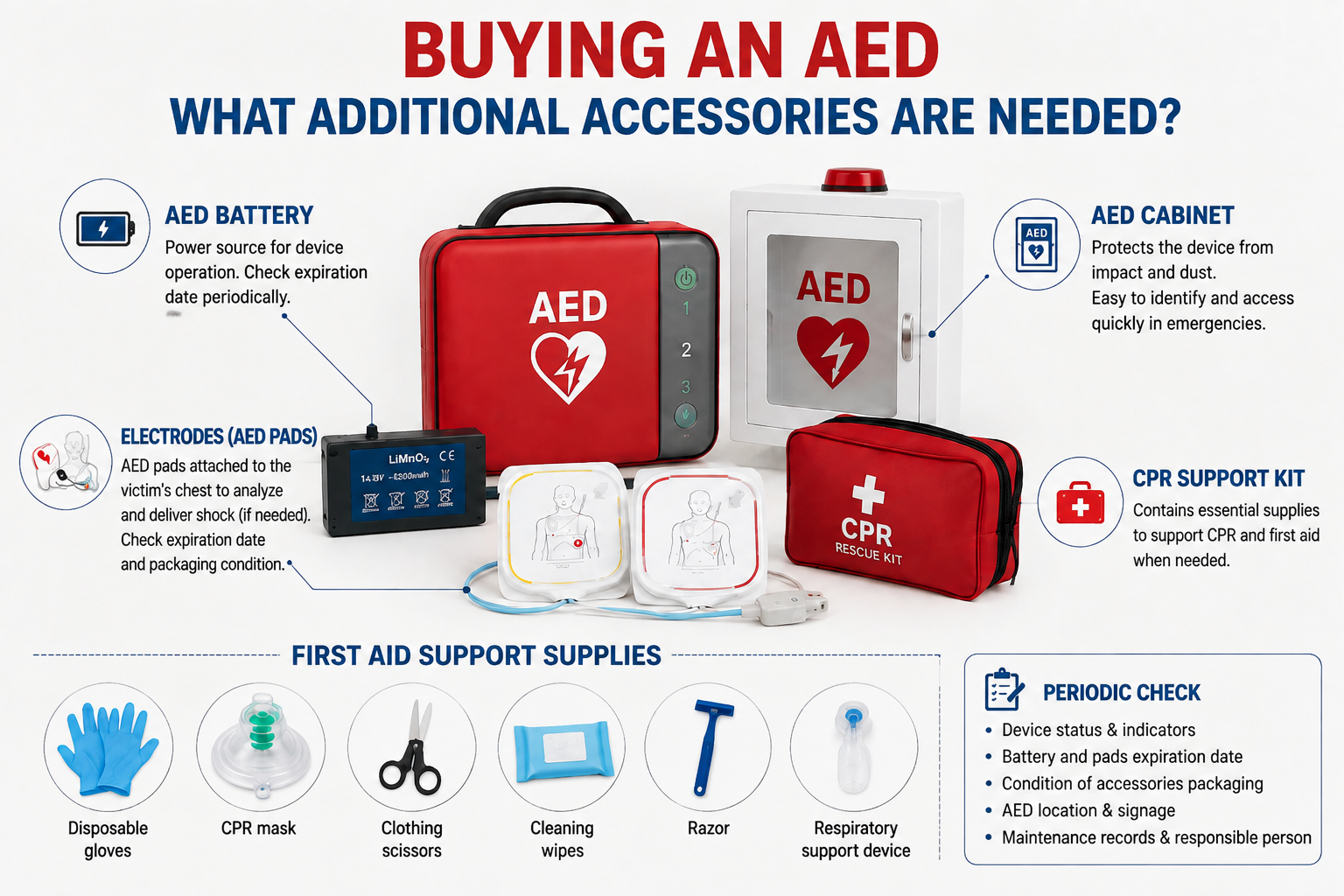 Image: A complete set of essential AED accessories, including an original battery, chest electrode pads, and a CPR support kit.
2. Why do AED pads need to be checked regularly?
AED pads are electrodes attached to the victim’s chest. They allow the device to analyze the heart’s electrical activity and, when necessary, deliver an electrical shock to help restore the heart rhythm. If the electrodes are not in proper condition, the AED may not function as expected during an emergency.
AED pads usually contain a conductive gel layer that helps create contact with the skin. Over time, this material may be affected by storage conditions and the expiration period specified by the manufacturer. Therefore, the person responsible for AED management should not only check whether the electrode package remains sealed but should also monitor the expiration date and readiness status of the pads according to the manufacturer’s instructions.
One important point is that each AED model may use a specific type of electrode pad. For example, electrode pads for the ZOLL AED 3 cannot be used with the Philips HeartStart FRx or NT-381C AED. Even if the external appearance is similar, the connection specifications and system design may be different. Before purchasing AED accessories, the following information should be checked:
Brand → AED Model → Accessory Code → Intended User → Expiration Date → Package Condition
This is a simple way to reduce the risk of purchasing incorrect AED pads.
3. When should AED pads be replaced?
AED pads should be replaced according to the expiration date and maintenance instructions provided by the manufacturer.
They should also be replaced earlier if:
- The packaging is damaged
- The electrodes have already been used in a previous emergency
A fixed replacement period should not be applied to all types of AED pads.
For businesses and organizations, when purchasing a new AED, it is recommended to record information including:
- AED model
- Pad model or accessory code
- Manufacturing date/expiration date
- Next inspection date
Organizations should not wait until an emergency occurs before checking whether the electrode pads are still usable.
4. Are AED batteries important?
AED batteries are an essential power source that allows the device to operate and must be managed according to the manufacturer’s instructions.
An AED placed in a convenient location cannot provide effective emergency support if the battery has expired or does not have sufficient power to operate the device.
Similar to AED pads, batteries are not interchangeable between all AED models. Each model has its own battery specifications and requirements.
Therefore, when replacing an AED battery, users should check the exact AED model and battery code according to the manufacturer’s documentation.
In addition to the expiration date, organizations should also pay attention to AED status indicators. Many devices have automatic self-testing functions to detect certain issues related to power supply or device readiness.
However, the warning systems vary depending on the model and should not completely replace regular inspection procedures.
5. Should you purchase spare AED batteries and pads when buying an AED?
It is recommended to have a plan for spare supplies; however, the number of replacement accessories required depends on the AED model, the manufacturer’s recommendations, and the organization’s equipment management plan.
Both AED pads and batteries have a limited service life. If an organization only purchases the AED device without managing replacement supplies, it may result in a situation where the device is still available, but essential accessories have already expired.
A good management system should maintain a separate record for each device:
AED → Model → Serial Number → Battery → Pad → Expiration Date → Inspection Date → Person in Charge
This management method is especially useful for organizations that operate multiple AEDs across different floors, locations, or facilities.
6. Is an AED cabinet necessary?
An AED cabinet is a storage solution that helps protect the device and makes it easier to identify and access in workplaces or public areas.
The choice of cabinet type should depend on the deployment location, equipment protection requirements, and the design of the surrounding area.
When selecting an AED cabinet location, organizations should not focus only on appearance. The most important factor is ensuring that, during an emergency, the assigned responder or bystander can quickly recognize the AED location and access the device.
A suitable AED cabinet helps users identify the device easily while ensuring that it does not create barriers when the AED needs to be retrieved quickly.
Organizations should also consider AED signage, location maps, and communication methods to ensure employees are aware of where the AED is installed.
7. Besides pads and batteries, what other supplies should organizations prepare?
Depending on the deployment model, organizations may prepare additional supplies to support the process of reaching the victim and performing CPR. However, these supplies are not considered mandatory AED accessories. As part of an emergency response kit, organizations may consider preparing items that support first aid procedures, such as:
- Disposable gloves
- Appropriate respiratory protection equipment
- Scissors for cutting clothing
- Cleaning and hygiene supplies
The selection of these items depends on the organization’s first aid training program and emergency response procedures. It is important to distinguish that: An AED does not replace a first aid kit, and a first aid kit does not replace an AED.
An AED serves a specific purpose within the chain of response for sudden cardiac arrest, while first aid supplies support responders in managing different emergency situations.
8. Can AED accessories from another model be used as replacements?
Users should not replace AED accessories with products that have not been confirmed as compatible by the manufacturer.
This is one of the most important principles when purchasing AED accessories.
When ordering replacement accessories, organizations should provide:
- AED brand
- AED model
- Device identification information or serial number (if required)
For organizations managing multiple AED models, it is recommended to create a list of compatible accessories for each device to avoid confusion during purchasing and maintenance.
9. How should AED accessories be checked before use?
AED accessories should be inspected regularly according to the manufacturer’s instructions.
The purpose is to ensure that both the device and its accessories remain in a ready-to-use condition.
A practical AED inspection process may begin with an external check, including:
- AED cabinet or storage box condition
- Device condition
- Status indicator light
- Any abnormal warning signals
After that, the inspection should include checking AED battery and pad records, especially:
- Expiration dates
- Packaging condition
FAQ: Frequently asked questions about AED accessories
Does an AED require a spare battery?
A spare battery may be considered depending on the AED model and the organization’s management plan. Some manufacturers recommend having a spare battery available. Organizations should follow the specific recommendations for their AED model.
For example, FDA documentation for the Philips HeartStart OnSite lists a spare battery as an optional accessory that can be purchased separately.
Can AED pads be shared between different AED models?
No. AED accessories must be confirmed as compatible with the specific AED model. Each manufacturer and AED model may have different connector designs, impedance requirements, and configurations. Therefore, electrode pads cannot be freely exchanged between different brands or models.
Do AED pads have an expiration date?
Yes.AED pads have a limited shelf life and must be replaced according to the manufacturer’s instructions.
How often should an AED be checked?
Organizations should establish a regular AED inspection schedule based on the manufacturer’s recommendations.
In general, many manufacturers recommend checking AEDs once a month. However, devices installed in harsh environments or locations with frequent use may require more frequent inspections, such as weekly checks.
Is an AED cabinet necessary?
An AED cabinet is recommended because it helps protect the device and improve visibility.
However, the cabinet design, including any locking mechanism or opening process, should not prevent rescuers from accessing the AED quickly during an emergency.
10.Conclusion
Providing an AED is only one part of building an effective sudden cardiac arrest response system.
For the device to work effectively in an emergency, organizations should also ensure that people who may be the first to respond have the necessary knowledge and skills. AED training helps participants understand how the device works, recognize signs of cardiac arrest, perform CPR (cardiopulmonary resuscitation), and coordinate AED use according to the correct emergency response procedure.
Wellbeing provides an integrated solution combining AED equipment supply with professional CPR training, including both theoretical knowledge and practical training. This approach helps organizations build a proactive emergency response system where equipment is ready, users are trained, and procedures are regularly reviewed.
The training program combines concise theoretical lessons with hands-on practice using real devices and training models. Participants are guided through essential skills, including:
- Assessing the condition of a victim
- Applying AED pads correctly
- Ensuring safety while the AED analyzes the heart rhythm and delivers a shock
- Coordinating as a team during an emergency
- Communicating effectively during the response process
By combining reliable AED equipment with proper training and regular maintenance, organizations can create a safer environment and improve their readiness to respond when sudden cardiac arrest occurs.
Comments:
There are no comment for this news.

.png)
.png)