 Tiếng anh
 Vietnam
Where Should AEDs Be Placed in Hotels and Resorts?
Where should hotels and resorts place AEDs? Discover how to choose accessible locations that support a faster emergency response and help keep guests and staff safe.
For hotels, priority locations to assess include the reception lobby, swimming pool, gym, restaurants, conference facilities, and other busy public spaces.
For large resorts with multiple buildings or outdoor facilities, placing a single AED at the reception desk should not automatically be considered sufficient to cover the entire property.
Instead, hotels and resorts should map their premises, assess actual access routes, and position AEDs so that staff can retrieve the device and bring it to someone experiencing cardiac arrest as quickly as possible while another responder begins CPR.
1. Why Is AED Placement Particularly Important in Hotels and Resorts?
An AED can play a vital role in responding to cardiac arrest, but its value depends on how quickly it can be accessed and used.
Hotels and resorts operate differently from typical office environments. The people on the premises include not only employees but also overnight guests, visitors using hotel facilities, children, older adults, international travellers, and individuals who may be unfamiliar with the property's layout.
A medical emergency can occur almost anywhere, including guest rooms, lobbies, restaurants, conference halls, swimming pools, gyms, recreational areas, beaches, sports facilities, or internal pathways.
When someone experiences cardiac arrest, the first person to discover the emergency is unlikely to be a doctor. It may be a receptionist, security guard, housekeeper, restaurant employee, fitness instructor, or even another guest.
According to the American Heart Association (AHA), AEDs are an important component of an effective cardiac arrest response system. This response begins with recognising cardiac arrest, activating emergency medical services, performing cardiopulmonary resuscitation (CPR), and using an AED as early as possible.
For hotels, the question is therefore not simply, "How many AEDs should we purchase?" It is equally important to ask, "Who will retrieve the AED, where will they get it, and which route will they take to reach the person in need?"
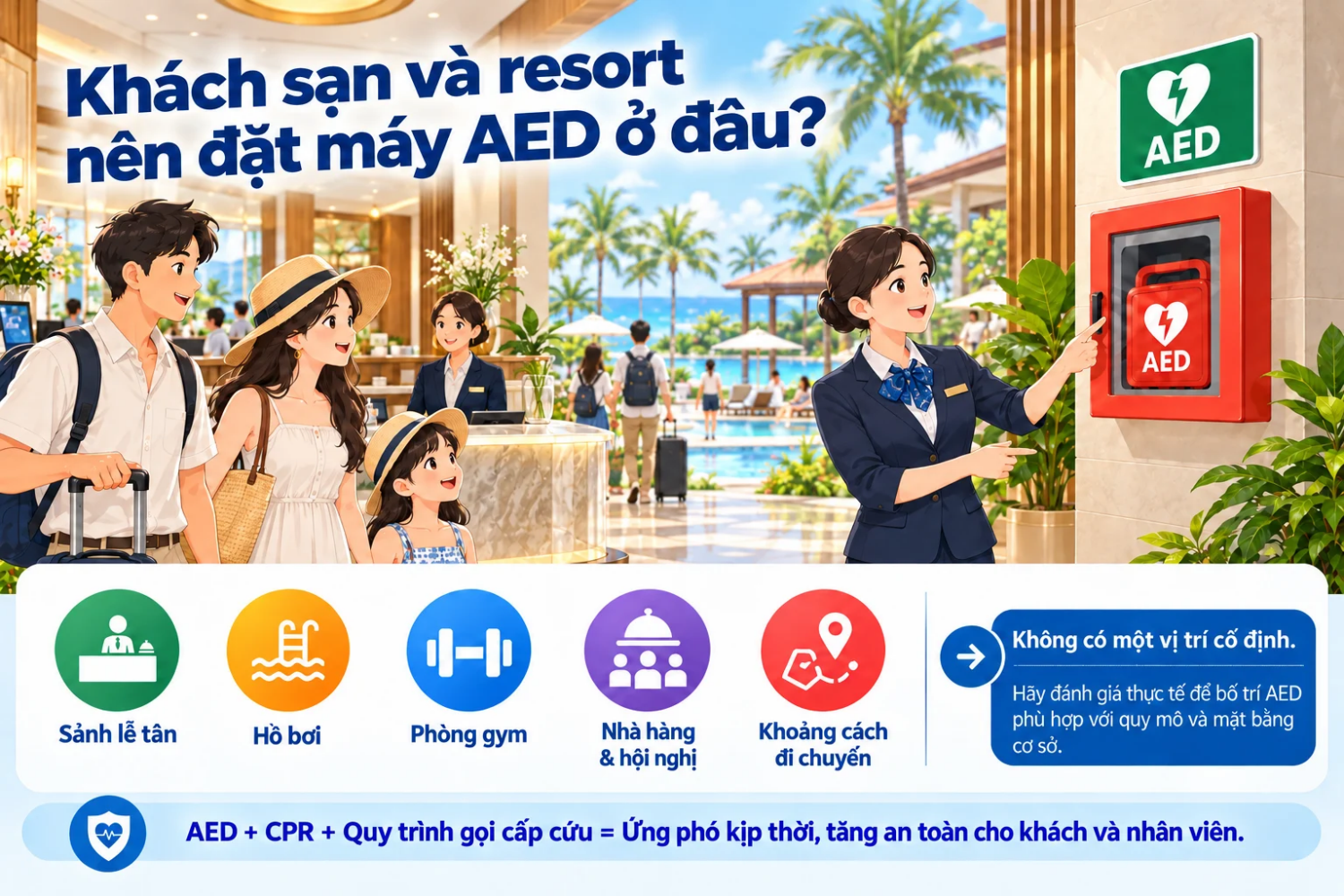
Image: AED Placement in Hotels and Resorts
2. Is One AED at the Reception Desk Enough?
The reception area can be a suitable location for an AED. However, in larger hotels and resorts, a single device at reception should not automatically be considered sufficient.
Reception desks are usually centrally located, regularly staffed, and easy for guests to find. These advantages make them a practical option for AED placement.
The challenge, however, lies in distance and accessibility.
Imagine a multi-storey hotel where a guest experiences cardiac arrest in an area far from the lobby. A staff member may need to return to reception to collect the AED before making their way back to the guest.
Security doors, lifts, long corridors, and crowded public areas can all increase the time required to retrieve the device. The actual journey may take considerably longer than the distance shown on a floor plan suggests.
This challenge can be even greater in resorts, where the main reception may be located some distance from swimming pools, private villas, restaurants, or the beach.
Reception may therefore be an important AED location, but it should not necessarily be the only one.
3. Should Swimming Pools Be Priority Locations for AED Placement?
Swimming pools should be among the priority areas considered when assessing AED placement in hotels and resorts.
Pool areas often attract large numbers of guests, involve water-based activities, and are typically monitored by pool attendants or lifeguards.
When planning AED placement near a swimming pool, hotels and resorts should consider the following:
-
The AED should be clearly visible, with easily recognisable signage.
-
The device should remain accessible whenever the facility is operating.
-
Access should not be restricted by locked cabinets or depend on a single person holding a key.
-
The AED should be stored in accordance with the manufacturer's environmental requirements.
-
Pool attendants and lifeguards should know where the AED is located and receive CPR and AED training.
-
There should be a practical route for bringing the device quickly to someone requiring assistance.
For resorts with several swimming pools, particularly those located far from the main facilities, each pool area should be assessed individually rather than assuming that one AED can serve the entire resort.
4. Should Hotels Install AEDs Near Gyms?
Gyms and sports facilities should also be considered priority areas when planning AED placement.
Fitness centres, exercise rooms, and sports facilities are places where guests may engage in vigorous physical activity. Unlike areas primarily used for relaxation, these spaces often involve sustained physical exertion.
If a hotel has its own gym, management should assess the route between the gym and the nearest AED:
Gym → Nearest AED location → Route to retrieve the device → Return route to the person experiencing an emergency.
An AED positioned in the corridor immediately outside a gym may be easier and quicker to access than one stored in a nearby locked room that requires staff to pass through several doors.
Gym employees should also know the exact location of the AED, how to recognise a medical emergency, who should contact emergency services, and how to provide immediate assistance while waiting for professional responders.
5. Do Restaurants and Conference Facilities Need AEDs?
AEDs may also be needed near restaurants, ballrooms, conference rooms, and event spaces, particularly where large numbers of people gather.
These areas often experience significant changes in occupancy depending on scheduled activities.
A hotel may have a relatively modest number of guests on an ordinary day, but a conference, wedding reception, or corporate event could bring hundreds of people into one location.
For this reason, AED planning should not be based solely on the number of guest rooms.
Hotels should also consider overnight guests, day visitors, employees, event attendance, and the size and layout of the property.
For example, an AED positioned in a public corridor near a ballroom may be more accessible during an emergency than one stored in a management office that guests and frontline staff cannot easily reach.
6. How Should AEDs Be Distributed Across Large Resorts?
Large resorts covering several hectares should be divided into separate emergency response zones rather than treated as one continuous area.
This is an important distinction between a hotel contained within a single building and a resort with facilities spread across an extensive property.
Resorts can begin by assessing the following areas:
|
Area |
Key Considerations |
Potential AED Locations |
|---|---|---|
|
Central facilities |
Reception and main lobby |
Lobby, reception, or another accessible public area |
|
Swimming pools |
Water-based activities and guest concentration |
A clearly visible, easily accessible location near the pool |
|
Gym |
Vigorous physical activity |
Near the gym entrance |
|
Restaurants |
High concentrations of guests |
Public areas close to restaurants |
|
Conference facilities |
Attendance that varies depending on events |
Near conference rooms or ballrooms |
|
Villas |
Accommodation spread across the property |
Locations selected according to distances and access routes |
|
Beach |
Outdoor environment |
A suitable location consistent with the resort's operating arrangements |
|
Sports facilities |
Physical and recreational activities |
Near sports areas |
|
Technical and staff areas |
Areas where employees regularly work |
Separate assessment where these facilities are far from central areas |
This table is not intended as a formula for determining a mandatory number of AEDs. Instead, it helps resorts identify locations where AED coverage may be insufficient.
AED deployment guidance emphasises the importance of assessing the entire property, including outdoor spaces and potential obstacles such as locked doors, staircases, lifts, corridors, and separate buildings.
7. How Can Hotels Determine Whether an Area Has Adequate AED Coverage?
Measuring distances on a map is not enough. Hotels and resorts should also test the routes employees would actually take to retrieve an AED and bring it to someone experiencing an emergency.
This provides a more realistic assessment of accessibility.
For example, consider the following route:
Swimming pool → AED at the lobby → Security-controlled door → Corridor → Lift → Retrieve AED → Return to the swimming pool.
The straight-line distance between the pool and the AED may appear short, but the actual journey could be much longer.
Hotels and resorts can evaluate AED accessibility through several practical steps:
-
Identify areas where guests and employees are regularly present.
-
Locate the nearest AED to each area.
-
Begin the assessment from the selected area, as though responding to an actual emergency.
-
Follow the exact route staff would use to retrieve the device.
-
Check for obstacles such as doors, lifts, staircases, security checkpoints, or restricted-access areas.
-
Assess whether the AED remains accessible outside regular business hours.
-
Identify areas where access may be delayed or inadequate.
-
Consider relocating existing AEDs or adding devices where necessary.
This practical approach is more useful than assuming that every hotel needs only one AED or calculating the number of devices solely according to guest room capacity.
8. How Does CPR and AED Training Improve Emergency Preparedness in Hotels?
Installing AEDs is only the first step. For these devices to be used effectively during cardiac arrest emergencies, employees also need the necessary knowledge and practical skills.
Hotels should pay particular attention to training staff members who are most likely to be the first to encounter a medical emergency.
These may include receptionists, security personnel, pool attendants, gym staff, shift supervisors, restaurant employees, and teams working in busy public areas.
Training should cover recognising cardiac arrest, activating emergency medical services, performing CPR, operating an AED, attaching electrode pads correctly, following safety precautions during rhythm analysis and shock delivery, and coordinating with other responders.
Hands-on practice using training manikins and AED equipment allows employees to become familiar with the procedures before an emergency occurs.
The goal is to ensure that staff are not using an AED for the first time when someone urgently needs their help.
9. Where Should AEDs Be Installed to Make Them Easy to Find?
AEDs should be placed in clearly visible locations, with recognisable signs and no furniture or other objects obstructing access.
During an emergency, the person searching for an AED may be unfamiliar with the property or may never have used the device before.
An AED hidden behind a reception desk, stored inside a closed cabinet, or placed in an area with little foot traffic may be difficult to locate quickly.
Hotels should use consistent AED signage throughout the property and include device locations in:
-
Floor plans.
-
Internal information boards.
-
Employee training materials.
-
Emergency response procedures.
-
Security department information systems.
-
New employee orientation programmes.
Clear signage and regularly communicated AED locations help employees identify and retrieve devices without unnecessary delays.
10. How Many AEDs Should a Hotel Have?
There is no single number of AEDs suitable for every hotel or resort.
The appropriate number should be determined by assessing the property's layout, occupancy levels, areas of activity, and how quickly each device can be accessed during an emergency.
Two hotels with a similar number of rooms may require very different AED arrangements.
For example:
Hotel A: A multi-storey building where the main facilities are concentrated around a central lobby.
Resort B: A large property with villas spread across different areas, swimming pools, restaurants, a gym, sports facilities, and a beach.
If AED numbers are calculated using only the number of guest rooms, important areas located far from the main building may be overlooked.
Instead of applying a fixed formula, hotels and resorts should follow a practical assessment process:
Property layout → Areas of activity → Access routes → Potential obstacles → Emergency response capability → AED quantity and placement.
11. What Else Should Hotels Prepare Besides AEDs?
AEDs are only one part of an effective emergency response system.
Hotels must also prepare their employees, establish clear procedures, and maintain the necessary medical equipment and supplies.
A comprehensive cardiac arrest response plan should include three essential elements.
-
People: Employees in key positions should know how to recognise cardiac arrest, call for assistance, perform CPR, and use an AED according to its instructions.
-
Procedures: Responsibilities should be clearly assigned, including who contacts emergency medical services, who retrieves the AED, who performs CPR, and how responders coordinate their actions.
-
Supporting equipment: Appropriate emergency medical equipment should be available, including AEDs and ventilation equipment such as bag-valve masks (Ambu bags) and rescue breathing masks.
12. Frequently Asked Questions About AEDs in Hotels and Resorts
12.1. What Should Hotels and Resorts Prioritise When Choosing AED Locations?
Priority should be given to areas with high occupancy, physical activities, long distances from existing AEDs, or conditions that could make access difficult during an emergency.
12.2. Do Small Hotels Need AEDs?
Small hotels should consider AED installation based on their facilities, guest numbers, layout, activities, and access to emergency medical assistance.
The decision should not be based solely on the number of guest rooms.
12.3. Is One AED Enough for a Resort With Multiple Swimming Pools?
Not necessarily. The number of swimming pools alone is not enough to determine whether one AED will provide adequate coverage.
Resorts should assess the distance between pools, the routes employees would take, staffing arrangements in each area, and how quickly an AED could reach someone in need.
Where pool areas are widely separated, additional AED locations may be necessary.
12.4. Can AEDs Be Installed Outdoors at Resorts?
AEDs should only be installed outdoors when both the device and its storage arrangements comply with the manufacturer's requirements.
Particular attention should be paid to temperature, humidity, water exposure, sunlight, and the recommended storage conditions for batteries and electrode pads.
12.5. Can Someone Without Medical Training Use an AED?
AEDs are designed to guide responders through the necessary steps during a medical emergency.
Users should follow the device's instructions, and CPR and AED training is strongly recommended to help them respond more effectively in real situations.
12.6. Is CPR Training Still Necessary if a Hotel Already Has AEDs?
Yes. CPR and AED use are complementary parts of cardiac arrest response.
Bystanders should quickly activate emergency medical services, begin CPR, and bring an AED to the person as soon as one becomes available.
13. Conclusion
There is no single AED placement strategy that works for every hotel or resort.
The most appropriate locations are those where AEDs are easy to identify, quick to retrieve, and can be brought to guests or employees in the shortest possible time under the property's actual operating conditions. For hotels, priority areas to assess include reception lobbies, swimming pools, gyms, restaurants, ballrooms, conference facilities, and other busy public spaces. For resorts, the assessment should also cover villas, sports facilities, beaches, outdoor recreational areas, and buildings located some distance from the main facilities. An AED can only make a meaningful difference when it is placed in the right location and used correctly. Hotels and resorts therefore need a comprehensive approach that combines appropriate medical equipment with practical first aid, CPR, and AED training for employees.
Choosing a reliable training and equipment provider can help each property develop a solution suited to its size, layout, and operational requirements. As a professional first aid training provider, Wellbeing offers integrated AED solutions and comprehensive CPR–AED training, combining essential knowledge with practical, hands-on instruction. These programmes help individuals and organisations strengthen their emergency response skills and build greater confidence in handling critical situations.
Register for a first aid training course with Wellbeing today to equip your team with the skills needed to respond promptly and effectively when an emergency occurs.
Comments:
There are no comment for this news.

.png)
.png)