 Tiếng anh
 Vietnam
Who Can Use an AED Machine?
Investing in AEDs and usage training is not only a safety solution but also a significant step forward in building a proactive, humane school environment ready to respond to any emergency situation.
In the context of an increasing focus on school health, the question "Who can use an AED machine?" is not merely technical but directly relates to the ability to save the lives of students and teachers in sudden cardiac arrest situations. Reality shows that, if used at the right time, an automated external defibrillator (AED) can significantly increase survival rates, especially in the first few minutes, the "golden window" of emergency care.
1. What is an AED and its role in the school health system?
In the context of enhancing school safety, the concept of school health does not stop at the medical room or specialized staff but is expanding to rapid response solutions for emergencies. One of the most important devices in this trend is the automated external defibrillator (AED).
An AED is a medical device capable of analyzing heart rhythms and delivering an electric shock upon detecting a dangerous arrhythmia such as ventricular fibrillation—the main cause of sudden cardiac arrest. The special feature of the AED is that it is designed for the community: the device can self-assess the victim's condition and guide the user step-by-step through voice prompts and visual cues. This helps minimize professional barriers, turning the AED into a crucial part of the modern school health ecosystem, where anyone can participate in saving lives if equipped with basic knowledge.
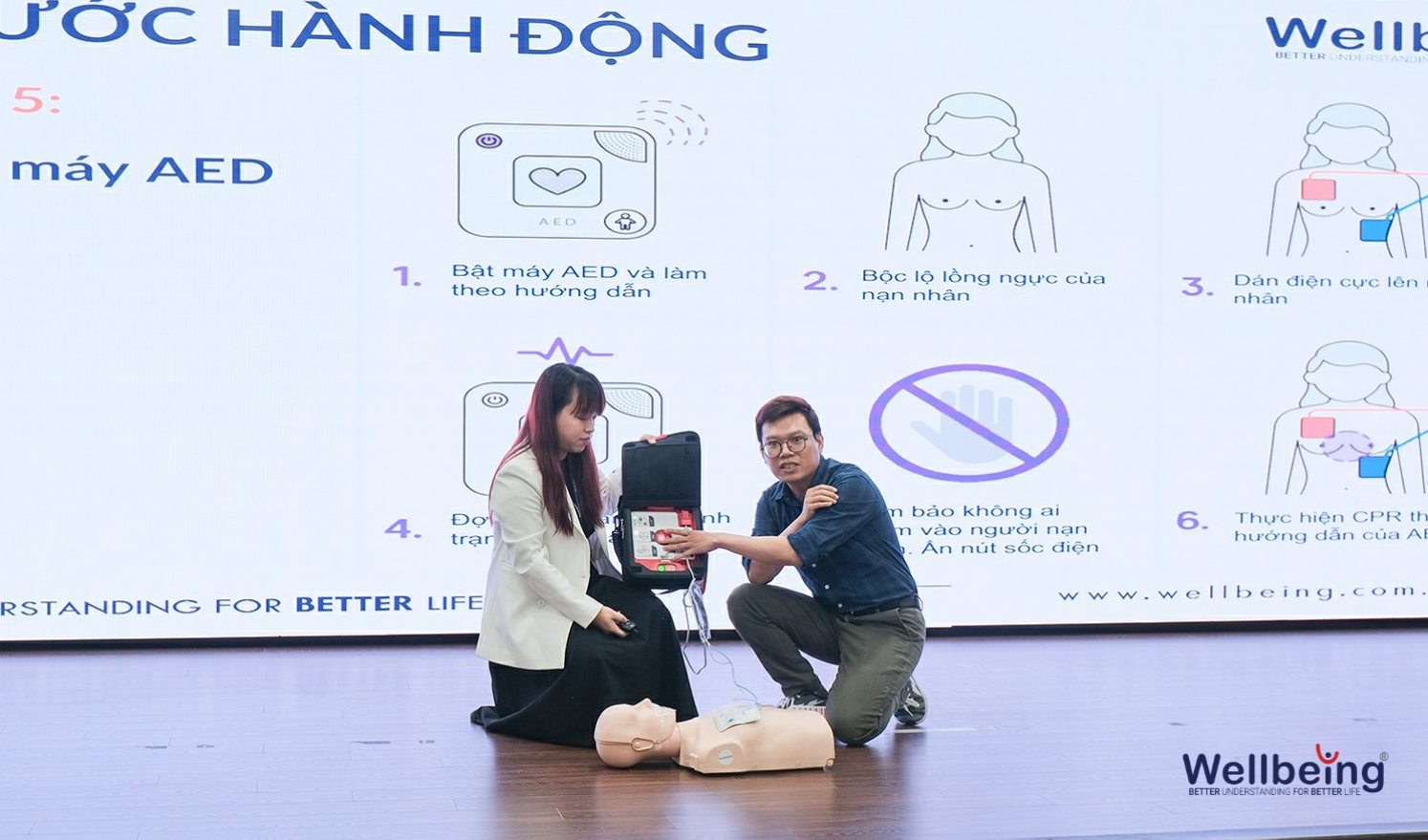
Equipping AED machines not only helps improve cardiac arrest emergency capabilities but also significantly contributes to building an out-of-hospital medical system in schools.
2. How does an AED work in an emergency?
Essentially, an AED is not just a defibrillator but also acts as an on-site "guide." When turned on, the machine automatically analyzes the victim's heart rhythm via electrode pads placed on the chest. If it detects a rhythm requiring defibrillation, the AED will prompt the user to stand clear and deliver a shock; if not, the machine will guide the user to perform cardiopulmonary resuscitation (CPR).
This mechanism is particularly important in the school health environment, where the first responders are often not medical personnel. Thanks to automation, the AED eliminates complex judgmental factors, ensuring that intervention is executed safely and at the right time. Given that every minute of delay reduces the chance of survival by about 10%, having a device like an AED provides a tremendous advantage.
3. The AED usage procedure in schools
For the AED to be effective in the school health system, users need to grasp the basic procedure rather than just understanding general theory.
-
When discovering an unconscious victim who is not breathing or gasping, the first step is to call for support and quickly bring the AED to the scene.
-
The user turns on the machine, attaches the electrodes as instructed, and follows the device's voice prompts.
-
While the machine analyzes the heart rhythm, absolutely do not touch the victim to ensure accuracy. (If the machine requires a shock, ensure no one is in contact with the victim before pressing the shock button).
-
After each cycle, the AED will continue to guide chest compressions and monitor until professional medical staff take over.
This procedure shows that the AED does not require complex operations but demands calmness and basic understanding. This is why in school health, popularizing AED usage skills must be accompanied by hands-on training rather than just equipping the device.
4. Who can use an AED in school health?
One of the biggest barriers today is the misconception that AEDs are only for medical personnel. In reality, AEDs are designed to serve the community, and in the school health system, this becomes even more apparent.
Teachers are often the first to approach students when an incident occurs, so their ability to use an AED can significantly shorten intervention time. School medical staff play a professional role but may not always be present at the scene immediately; therefore, they cannot be the only force in charge of this device.
Additionally, groups such as security guards, administrative staff, or facility managers are frequently present in public areas—where the risk of incidents is higher. Expanding training to these groups helps create an effective rapid response network throughout the school.
Notably, high school students can also be trained to use AEDs as a life skill. In many countries with developed school health systems, teaching first aid and AED usage has become part of the educational curriculum, contributing to building a more proactive and safer school environment.
5. The role of training: From "having the device" to "knowing how to use it"
AEDs are used when the victim shows signs of circulatory arrest, such as being unconscious, not breathing, gasping, or having no pulse. In the school health environment, these situations can occur unexpectedly during class, physical activities, or crowded events.
The important point is that the user does not need to make complex medical decisions. The AED will self-analyze and only shock when necessary, helping to minimize the risk of error. However, the device's effectiveness depends on rapid situation recognition and timely deployment.
This emphasizes the role of training in school health: it is not just about knowing there is an AED, but knowing "when to use it and how to use it."
6. Wellbeing - A comprehensive solution from equipment to AED training in schools
To deploy AEDs effectively in school health, a synchronized approach is needed rather than just stopping at purchasing equipment. Wellbeing currently provides an integrated solution, combining equipment, training, and practical operational support.
Wellbeing offers genuine AED models from reputable brands such as Zoll, Defibtech, Philips, Nihon Kohden, and Nanoomtech, with the advantages of being easy to use, featuring voice guidance, and being suitable for the school environment. These devices all meet international standards, have high durability, and are suitable for deployment in public areas.
Besides, Wellbeing organizes first aid and AED usage training courses where practical time accounts for up to 70%, helping trainees not only understand but also proficiently execute in reality. The program is taught by a team of experts and emergency doctors, ensuring accuracy and up-to-date information.
Furthermore, Wellbeing supports consultation on installation locations, building emergency response procedures, and providing accompanying first aid kits, helping schools build a comprehensive and sustainable school health system.
The answer to "Who can use an AED machine?" is no longer limited to medical personnel but expands to the entire school community. In a modern school health system, anyone—from teachers and staff to students—can become a lifesaver if equipped with the right knowledge and skills.
Comments:
There are no comment for this news.
.png)
.png)