 Tiếng anh
 Vietnam
Why Should a 100-Employee Office Consider Having an AED?
Does a 100-employee office need an AED? Explore key factors for AED placement, device quantity, CPR/AED training, and workplace cardiac arrest response.
The answer is yes. An office with 100 employees should consider having an AED, but the number of devices should not be determined solely based on the number of people. A more important factor is how quickly someone can access and bring the AED to the location where it is needed, especially in offices with multiple floors, large areas, or distributed workspaces.
An Automated External Defibrillator (AED) is a device designed to analyze heart rhythm and deliver an electrical shock to restore an effective heartbeat when necessary. In sudden cardiac arrest emergencies, an AED should be used as soon as possible together with cardiopulmonary resuscitation (CPR).
Therefore, for an office with around 100 employees, the key considerations are not only “Does the company need an AED?” but also where the device should be placed, who can use it, how it can be accessed quickly, and how to ensure the equipment remains ready for use at all times.
1. Why Should an Office With 100 Employees Consider Having an AED?
Out-of-hospital cardiac arrest can happen to anyone, anywhere, and at any time.In the United States, more than 10,000 people experience cardiac arrest in the workplace each year. In the United Kingdom, approximately 15% of cardiac arrest cases are estimated to occur in offices and manufacturing facilities. More than 90% of victims of out-of-hospital cardiac arrest will die without timely intervention. If CPR is combined with AED use during the first few minutes after cardiac arrest, the victim’s chance of survival may increase by more than 70%. Therefore, equipping offices and workplaces with AEDs is extremely important.
According to the American Heart Association (AHA), early CPR and early defibrillation are key components of the chain of survival for people experiencing cardiac arrest. An AED can analyze heart rhythm and deliver an electrical shock at an appropriate energy level, providing early support while waiting for professional emergency responders.
This is a solution that businesses may consider when developing a workplace cardiac arrest response system, especially in environments where employees often work together in the same building for many hours each day.
Instead of passively waiting for an ambulance to arrive, businesses can proactively build an initial response system with CPR and AEDs, while also training employees to recognize emergencies and perform the necessary steps.
 Image caption: AED in the workplace: It is not only important to have an AED, but also to place it in the right location for quick access when an emergency occurs.
2. AEDs in the Workplace and Their Role in Cardiac Arrest Response
An AED is not simply a device that delivers an electrical shock to an unconscious person. It is a defibrillation device designed to analyze the heart’s electrical activity and only recommend a shock when a shockable heart rhythm is detected.
AED, which stands for Automated External Defibrillator, is used by placing electrodes on the chest of the person experiencing an emergency to record the heart’s electrical activity. Once the AED pads are connected, the device automatically analyzes the heart rhythm and provides instructions to the rescuer. During this process, bystanders must not touch the victim to ensure that the analysis is performed accurately and safely.
One important reason why AEDs are suitable for workplaces without a medical background is that users do not need to know how to interpret an electrocardiogram (ECG) to decide whether defibrillation is needed. The device automatically provides guidance based on the analysis results. If a shockable rhythm is detected, the AED will provide instructions on the next step to deliver an electrical shock. If no shock is recommended, the device will continue guiding the rescuer to perform CPR at the appropriate rate according to its programmed instructions.
Therefore, the value of an AED does not only lie in “delivering a shock as soon as possible”, but also in its ability to guide rescuers in performing high-quality CPR (with the correct rate and depth). This is the basis for businesses to consider AEDs as part of a workplace first aid response system, rather than simply viewing them as a medical device stored inside a cabinet.
3. How Many AEDs Should an Office With 100 Employees Have?
The number of AEDs required should be determined based on actual accessibility, facility characteristics, and workplace layout. An office with 100 employees working together in a centralized area will have very different AED accessibility conditions compared with a company that also has 100 employees but distributes them across multiple floors or separate work areas.
For example, a company may have employees working on the 1st, 3rd, 5th, and 7th floors. If there is only one AED located on the 1st floor, the device is available within the building, but this does not mean that every area has the same level of access. Especially during an emergency, responders may need to move through hallways, access-controlled doors, or use elevators before bringing the device to the victim.
Therefore, instead of applying a simple formula such as “100 employees equal how many AEDs,” businesses should evaluate the actual ability and time required to bring an AED to the location where an emergency occurs. This factor is much more valuable than simply looking at the total number of employees.
The appropriate way to determine AED placement is to create a facility layout map, mark the proposed AED locations, and simulate the travel routes from working areas to the device. Through this process, businesses can identify areas with good coverage, locations where access may be delayed, and determine whether additional AEDs are needed for the workplace.
4. Factors to Consider When Determining the Number of AEDs
4.1. Office Area and Level of Workplace Distribution
Large areas, multiple separated sections, or multi-floor offices usually require businesses to conduct a more detailed assessment of their AED access network.
The distance shown on a floor plan does not always accurately reflect the actual access time.
An AED may appear to be located close to a working area, but the person retrieving the device may still need to pass through access-controlled doors, find keys, wait for an elevator, or move through crowded areas.
Therefore, assessing the need for AEDs in the workplace should include potential obstacles along the access route.
A device is only truly effective when employees know where it is located, can retrieve it quickly, and can bring it to the victim during an emergency.
4.2. Characteristics of Multi-Floor Offices
A multi-floor office does not automatically mean that an AED must be placed on every floor.
However, the number of floors is an important factor when evaluating AED accessibility.
If a single AED is placed on the ground floor while working areas are located on higher floors with complex travel routes, businesses should consider whether the current arrangement can meet their emergency response objectives.
When distance or travel conditions create significant delays, adding additional AED locations may be a more appropriate solution.
In addition to the number of floors, businesses should also consider factors such as elevator availability, restricted access areas, working hours, after-hours activities, and the ability to access the device when there are not enough management staff present in the office.
These factors determine the actual availability and effectiveness of an AED, rather than simply the location of the device shown on a floor plan.
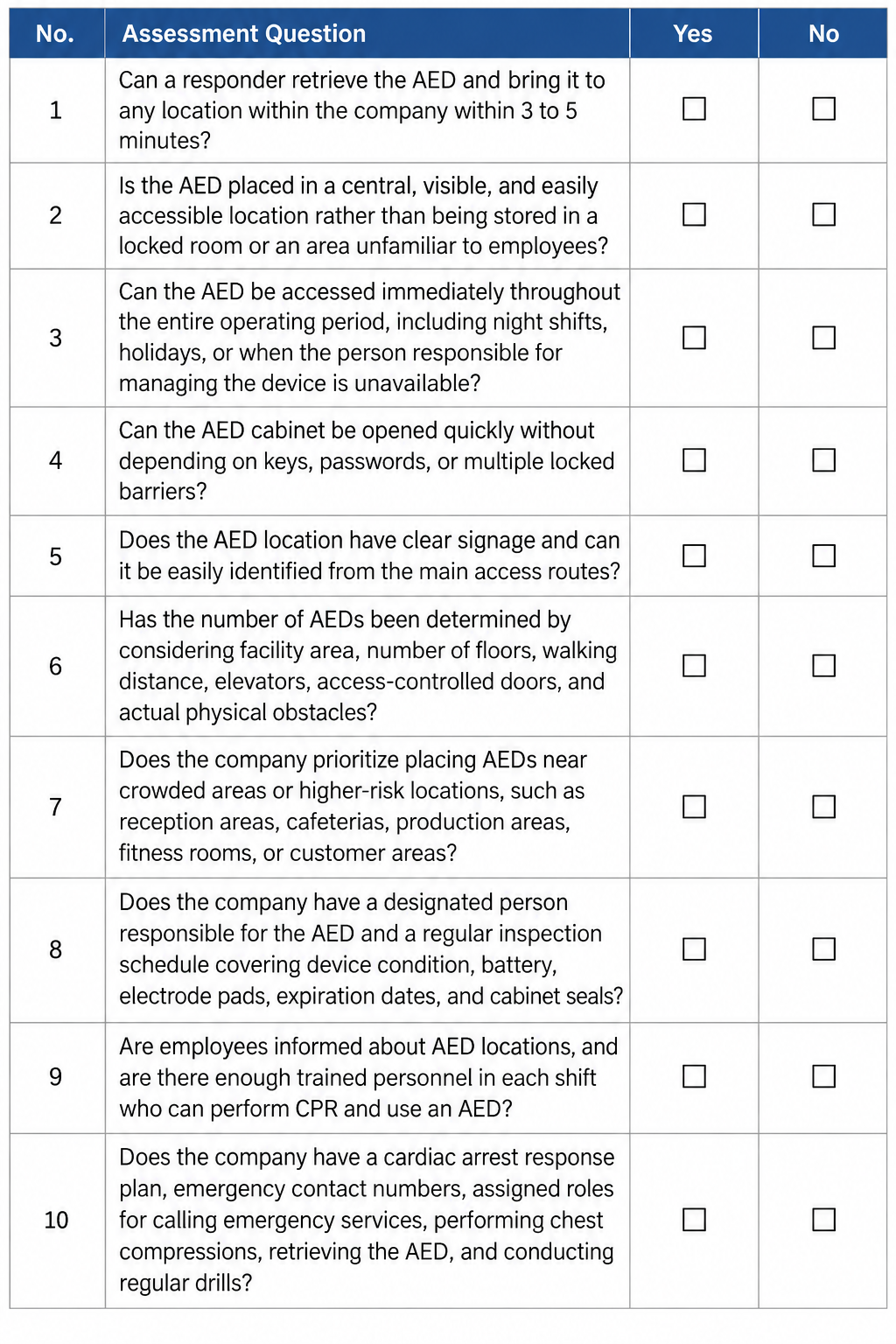
5. How to Assess Whether an Office With 100 Employees Has Properly Positioned Its AED?
The following checklist can be used to identify gaps in the office emergency response system.
 6.Which AED Implementation Model Should a 100-Employee Office Follow?
Businesses should implement AED deployment according to the following model:
Assessment → Placement → Training → Inspection → Improvement
Step 1: Assess the workplace layout and AED accessibility:
The company should survey working areas, identify distances, elevator access, emergency exits, hallways, meeting rooms, and other factors that may affect AED accessibility. The impact of these factors on the time required to reach the AED should be evaluated.
Step 2: Place AEDs in locations that are easy to recognize and access:
Select appropriate locations for AED placement, install clear signage and AED cabinets, ensure accessibility, consider the ability to retrieve the device outside normal working hours, and pay attention to locations that may appear convenient but could actually cause delays during an emergency.
Step 3: Build a workplace first aid response team with basic emergency skills:
Clearly define the role of each person in an actual emergency situation, including the person who identifies the incident, the person who calls emergency services, the person who retrieves the AED, the person performing CPR, and the person guiding medical responders to the scene.
Step 4: Provide CPR training combined with AED operation guidance for all employees:
Employees should be informed about what the training program includes, why CPR training should be combined with AED use, and why the entire response process should be practiced rather than only learning how to operate the device.
Step 5: Establish AED management and maintenance procedures:
Check AED accessories to ensure the device remains in a ready-to-use condition. Pay attention to expiration dates, conduct regular inspections, and assign a person responsible for AED management.
Step 6: Conduct regular training, inspections, and drills to evaluate actual response capability:
Organize training sessions, develop emergency drill scenarios, define the key time points that need to be assessed, identify bottlenecks, and determine how to adjust AED placement or response procedures after each drill.
7. FAQ: Frequently Asked Questions About AEDs for Offices
7.1 Is an office with 100 employees required to have an AED?
It cannot be concluded that every office has the same AED requirements simply based on having 100 employees. Businesses need to consider factors such as industry characteristics, location, current regulations, and specific risk assessments.
From a safety perspective, an AED is a device worth considering to improve the ability to respond when sudden cardiac arrest occurs.
7.2. How many AEDs should an office with 100 employees purchase?
There is no fixed number that applies to every office. If employees work in a centralized area, one AED placed in an appropriate location may be an initial solution.
If the office has multiple floors or distributed working areas, businesses should evaluate AED accessibility and may need additional AED locations.
7.3. Can someone who is not a doctor use an AED?
Yes. AEDs are designed to support rescuers through voice and/or visual instructions.
However, businesses should provide CPR and AED training for employees so they can recognize emergency situations and use the device according to the correct procedure.
7.4. Is an AED required on every floor of a building?
It is not mandatory to have one AED on every floor. Businesses should base their decision on actual accessibility, workplace layout, and emergency response planning.
If a single AED cannot be delivered to distant areas quickly enough, additional devices should be considered.
7.5. Can an AED accidentally deliver a shock to someone whose heart is beating normally?
No. An AED analyzes the heart rhythm before determining whether defibrillation is required.
The device is not designed to deliver a shock simply because a person is unconscious. If the AED determines that a shock is not needed, it will not provide defibrillation therapy.
7.6. Should an AED be placed in the company’s medical room?
It is possible, but a medical room is not always the optimal location.
The AED location should prioritize quick recognition and rapid access. The device should not be placed in an area where only one person knows its location or where access depends on waiting for someone with a key.
8. Conclusion
An office with 100 employees should consider having an AED, but the number of employees should not be the only factor used to determine the number of devices required.
An effective AED solution for an office should answer four key questions:
- Where should the AED be placed?
- How long does it take to bring the device to the victim?
- Who will perform CPR?
- Who will retrieve the AED when an emergency occurs?
Providing an AED is only one part of a sudden cardiac arrest response system.
For the device to be effective during an emergency, people who may be the first to reach the victim must also be equipped with the necessary knowledge and skills.
AED training programs help participants understand how the device works, recognize signs of cardiac arrest, perform CPR (cardiopulmonary resuscitation), and coordinate AED use according to the correct procedure.
Wellbeing provides an integrated solution combining AED equipment with comprehensive CPR–AED training, including both theoretical knowledge and practical skills. This helps build a proactive response system where equipment is always ready, users have the necessary skills, and procedures are regularly reviewed.
The training program combines concise theoretical instruction with hands-on practice using training models and real equipment, including skills in victim assessment, AED pad application, ensuring safety while the device analyzes the heart rhythm and delivers a shock, team coordination, and communication during emergency situations.
Comments:
There are no comment for this news.

.png)
.png)