 Tiếng anh
 Vietnam
Safety Regulations in Electrical Operation
Electrical safety requires workers to undergo training, be issued safety cards, fully utilize personal protective equipment (PPE), and strictly follow operating procedures that include technical safety measures (power disconnection, voltage testing, grounding, shielding, and posting warning signs). Additionally, it requires the use of equipment that meets technical standards, as well as the regular inspection and maintenance of electrical systems and devices. At the same time, users must possess basic knowledge to prevent electric shock accidents and fire hazards.
1. Overview of Electricity and Electrical Safety
Electrical energy is an essential power source for operating the entire modern economy, from complex automated production lines to daily living needs. In the era of industrialization and digital transformation, electrical energy acts as a vital driving force for all production and living activities. However, along with immense benefits come potential risks of fire, explosion, and occupational accidents if not strictly managed. Electrical accidents often leave devastating consequences for people and property, causing production interruptions and affecting a business's reputation.
According to Clause 2, Article 4 of the 2024 Electricity Law, electrical safety is defined as a solution to prevent and combat the impacts of hazardous factors to stop harmful effects and ensure safety for humans, equipment, and structures during the generation, transmission, distribution, and use of electricity. Compliance with electrical safety standards is a mandatory legal requirement stipulated in the Electricity Law and National Technical Regulations, and it is a compulsory obligation for all organizations and individuals participating in electricity activities and usage. This aims to ensure the safety of human life, protect property, and maintain the stability of the national energy system.
2. Standards for Workers Participating in Electrical Operations
According to legal regulations, work related to electrical systems is not for everyone. Workers performing operations, testing, construction, installation, or repair of electrical lines or equipment must meet specific conditions.
First, regarding age and health, workers must be 18 years of age or older and have adequate health to work as prescribed by law. Ensuring health is a prerequisite that helps operators maintain alertness and quick reflexes in dangerous situations.
Second, regarding professional qualifications, workers must have appropriate degrees or vocational certificates. Specifically, the law requires workers to hold a degree or vocational certificate suitable for the assumed work, issued by a vocational education institution or an active vocational education facility under legal regulations. This ensures they are equipped with a solid foundational knowledge of electrical engineering.
Third is the requirement for safety training. Workers must be trained, pass electrical safety tests, and be issued an electrical safety card in accordance with Article 4 of Circular 05/2021/TT-BCT. The electrical safety card is a mandatory certification, confirming that the personnel have mastered safe working procedures and are ready to participate in actual operational tasks.
Specifically, according to Article 4 of Circular 05/2021/TT-BCT, subjects required to be trained, tested, graded, and issued electrical safety cards include:
-
Persons operating, testing, constructing, installing, or repairing electrical lines or equipment in enterprises, including hanging, removing, checking, and calibrating electricity measuring and counting systems; and dispatchers.
-
Persons operating and repairing electricity in rural, mountainous, border, and island areas belonging to organizations operating under the Electricity Law and other relevant laws, within those specific areas.
-
Workers whose profession is operating, repairing, or providing electrical services for organizations and enterprises.
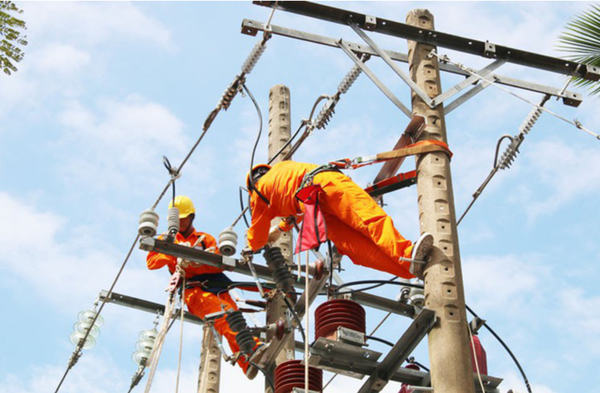
Workers doing electrical operation work must be trained, pass electrical safety tests, and be issued an electrical safety card.
3. Content of Training and Electrical Safety Grading
To ensure the quality of human resources, electrical safety training is divided in detail depending on the job position. According to Circular 05/2021/TT-BCT, the training content is divided into two main parts: theory and practice. Based on Articles 5 and 6 of Circular 05/2021/TT-BCT, the theoretical part equips workers with foundational knowledge about system diagrams, organizational measures (such as the Work Permit and Work Order systems), technical measures to prepare a safe workplace, risk identification skills, and electrical accident first aid procedures. The practical part requires workers to be proficient in using and maintaining safety equipment and personal protective equipment, and to master the methods of separating victims from power sources as well as actual incident handling operations.
Based on the nature of the work, workers are divided into electrical safety grades from 1 to 5 as prescribed in Article 9 of Circular 05/2021/TT-BCT. Specifically:
-
Grade 1/5 is for those who do not come into contact with power sources or only participate as assistants.
-
Grade 2/5 allows working in areas that have been completely de-energized.
-
Grade 3/5 entitles workers to work directly with live low-voltage grids, perform operations on high-voltage grids, and gives them the right to command and issue work orders for the low-voltage section.
-
Grade 4/5 maximally expands professional authority, allowing direct work with live high-voltage grids and the issuance of work permits for high-voltage systems.
-
Grade 5/5 is the highest level, permitting the execution of all work within the assigned management scope.
4. Technical Procedures During Electrical Operation
According to the 2024 Electricity Law, organizations and individuals using electricity for production must strictly comply with National Technical Regulations on electrical safety. Electrical systems at production facilities must be designed, installed, and operated according to standards, ensuring safe technical parameters. Electrical operation and repair activities must strictly comply with the "Work Permit" or "Work Order" procedures. Before performing any work on the power grid, the first and most important step is to disconnect the power and prevent it from being re-energized. The executor must lock the drive mechanism of the switching devices and hang a warning sign stating "Do Not Close Circuit - Men at Work" at these locations.
After disconnecting the power, technicians are obligated to verify the absence of voltage using a voltage tester or specialized measuring equipment. Immediately after, grounding at the workplace must be carried out. Grounding acts as a life shield, helping to direct the current to the ground in the event of a leak or accidental re-energization. Additionally, temporary barricades should be set up in the work area to isolate it from surrounding live parts. During operation, workers must absolutely not work alone on tasks with strict safety requirements or when working at heights or near high-voltage lines. Mutual supervision helps detect errors promptly and supports immediate handling when an incident occurs.
One of the key requirements is technical safety inspection. Electrical equipment, electrical tools, and protection systems must undergo initial inspection before being put into use, periodic inspection during operation, and extraordinary inspection when there are signs of hazards or after major repairs. Using substandard or expired equipment is a serious violation of the law.
For substations and power lines within an enterprise's managed area, the investor is responsible for periodic maintenance and servicing. The power grid safety corridor must be kept clear, without obstacles or structures violating safe discharge distances. Especially in areas with a high risk of fire and explosion, the electrical system must be a specialized explosion-proof type and comply with fire prevention and fighting regulations.
5. Incident Handling and First Aid for Electrical Accidents
No matter how strict the procedures are, risks can still occur. Therefore, accident handling skills are mandatory knowledge for all personnel. When discovering someone being electrocuted, the first principle is to quickly separate the victim from the power source by turning off the circuit breaker, aptomat, or using dry insulating objects like a wooden stick, plastic, etc., to push the wire away. Absolutely do not touch the victim directly when the power has not been cut.
First aid skills for electrical accidents are mandatory knowledge for all personnel. Photo: Internet
After removing the victim from the danger zone, it is necessary to immediately check their respiratory and cardiovascular status. If the victim stops breathing or their heart stops beating, artificial respiration and chest compressions (CPR) must be performed immediately until medical personnel arrive. At the same time, the person discovering the incident must immediately report it to the person in charge and keep the scene intact for cause investigation purposes according to regulations.
Mastering and complying with legal electrical safety regulations not only helps businesses avoid legal risks but, more importantly, protects human life and property. A standard operating procedure, combined with the high disciplinary awareness of workers, will be a solid foundation for the sustainable development of the business. Remember, in the electrical industry, a single second of negligence can cost a lifetime; therefore, safety is always the number one priority.
References:
-
Thư viện pháp luật (Law Library), Circular 05/2021/TT-BCT detailing certain contents on electrical safety, accessed: https://thuvienphapluat.vn/van-ban/Thuong-mai/Thong-tu-05-2021-TT-BCT-quy-dinh-chi-tiet-mot-so-noi-dung-ve-an-toan-dien-483505.aspx
-
Thư viện pháp luật (Law Library), What is electrical safety, what are the regulations on electrical safety? Which subjects are employers responsible for organizing electrical safety training for?, accessed: https://thuvienphapluat.vn/lao-dong-tien-luong/an-toan-dien-la-gi-quy-dinh-ve-an-toan-dien-the-nao-nguoi-su-dung-lao-dong-co-trach-nhiem-to-chuc-h-39741.html
Comments:
There are no comment for this news.

.png)
.png)